
What Is Customer Support Outsourcing? The Complete 2026 Guide
Customer support outsourcing has changed. It is no longer a cost-cutting decision made reluctantly when headcount budgets get tight. In 2026, it is a strategic operating model chosen by startups, mid-market businesses, and global enterprises to scale customer experience faster than in-house hiring allows — while accessing technology and talent that would be prohibitively expensive to build internally. This guide explains what customer support outsourcing is, how the models work, what it costs, what it delivers, and how to choose a partner that protects your brand rather than diluting it.
Quick Answer: Customer support outsourcing means contracting a third-party Business Process Outsourcing (BPO) provider to handle customer service interactions — across phone, email, live chat, and social — on behalf of your business. According to Zendesk’s 2026 CX Trends report, outsourcing can cut support costs by 30–60% versus in-house teams while improving CSAT scores when managed with clear SLAs and structured QA. The global BPO market is projected to reach $491 billion by 2030 (Statista).
What Customer Support Outsourcing Actually Includes
Outsourcing does not mean handing a phone number to a call centre and walking away. Modern BPO engagements cover a complete support operation:
- Inbound and outbound phone support: handling calls across customer service, technical support, billing enquiries, and sales.
- Email support: managing ticket queues, responding within agreed SLAs, escalating complex cases.
- Live chat: real-time website chat handled by dedicated agents trained on your brand and products.
- Social media support: monitoring and responding on Facebook, Instagram, Twitter/X, and other relevant platforms.
- Virtual assistant services: administrative tasks, scheduling, data entry, and back-office support handled remotely.
- AI-augmented support: BPO providers now embed chatbots, sentiment analysis, and predictive routing into their operations — agents handle escalations while AI handles routine queries.
- Quality assurance and performance analytics: structured QA programmes, CSAT measurement, and regular reporting are included with reputable providers.
The scope you outsource can be partial (after-hours coverage only), full (all customer interactions), or channel-specific (chat and email only, with phone in-house).
The Four Outsourcing Models Explained
1. Onshore Outsourcing
Agents are based in the same country as your business. Highest cost, lowest cultural and language risk. Best for regulated industries (healthcare, legal, finance) where compliance and communication precision are non-negotiable.
2. Nearshore Outsourcing
Agents are in a nearby country or region with overlapping time zones. For UK and European businesses, popular nearshore markets include Romania, Poland, and Portugal. For US businesses: Mexico, Costa Rica, and Colombia. Offers a cost saving of 30–50% over onshore at lower language and timezone risk than offshore.
3. Offshore Outsourcing
Agents are based in lower-cost regions — the Philippines, India, Vietnam, and Malaysia are the dominant offshore markets in 2026. The Philippines has taken the lead in customer service specifically, thanks to high English proficiency and a culturally Western-aligned workforce. Offshore hourly rates run $9.50–$15/hour versus $25–$60/hour for onshore US/UK agents (2026 data from Ever-Help’s outsourcing cost research).
4. Hybrid Model
A combination of in-house and outsourced teams. Often structured as: in-house team handles complex, relationship-critical, or highest-value interactions while the BPO partner handles volume, after-hours coverage, and routine channels. This is the most common model for businesses that want to protect certain interactions while dramatically reducing the cost of routine support volume.
| Model | Cost vs In-House | Best For | Key Trade-off |
| Onshore | 5–15% saving | Regulated industries, complex support | High cost, limited savings |
| Nearshore | 30–50% saving | EU/US businesses, quality-sensitive | Moderate savings, good quality |
| Offshore | 50–70% saving | High volume, multilingual, 24/7 coverage | Requires strong onboarding |
| Hybrid | Variable | Businesses protecting some interactions | Management complexity |
What Does Customer Support Outsourcing Cost in 2026?
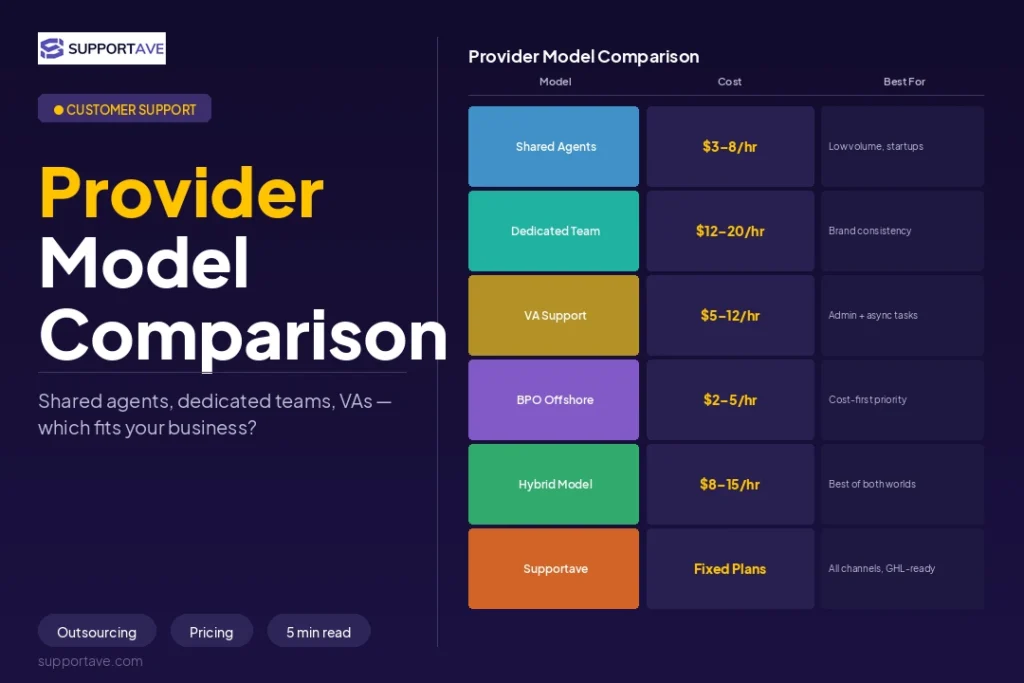
Costs vary by model, location, and service complexity. According to GigaBPO’s 2026 industry analysis (combining data from Clutch, G2, and direct RFP data), typical pricing breaks down as follows:
- Per-ticket pricing: $1.10–$4.50 per ticket, depending on channel and complexity.
- Per-agent monthly: $1,800–$4,500/month for a dedicated offshore agent. $4,000–$8,500/month nearshore. $6,000–$15,000/month onshore.
- Hourly rates: $9.50–$15/hour offshore, $15–$30/hour nearshore, $25–$60/hour onshore (US/UK).
- Startups and SMBs outsourcing Level 1 support (routine inquiries) can expect 20–35% cost reductions compared to building a local in-house team (GigaBPO 2026 benchmark).
- Enterprises shifting to offshore shared agents for after-hours or multilingual support can save up to 40–70% on those specific functions.
Hidden costs to budget for: Setup and onboarding fees ($1,000–$5,000 one-time), software licences for tools the BPO uses on your behalf, QA platform subscriptions, and transition management time from your internal team. Budget 15–20% above the per-agent quote for a realistic first-year total.
The Real Benefits of Outsourcing Customer Support
Cost Efficiency
Outsourcing eliminates expenses that do not appear in a headcount comparison: office space, equipment, employer pension and national insurance contributions, HR management, training infrastructure, and employee turnover cost (which averages 33% of annual salary per replacement, per SHRM data). According to Text.com’s 2026 BPO pricing guide, businesses that factor in full in-house total cost consistently find outsourcing saves 30–60% even at nearshore rates.
Scale Without Lag
An in-house team takes 6–12 weeks to hire, onboard, and train a new agent. A BPO partner can ramp an additional 10 dedicated agents in 2–4 weeks. For product launches, seasonal spikes, or geographic expansion, the ability to scale support capacity on demand — without the lag time and risk of traditional hiring — is frequently worth the cost premium alone.
24/7 Coverage Without Night Shifts
Providing genuine 24/7 phone and chat coverage with an in-house team requires a minimum of four full-time agents to cover rotating shifts, plus management overhead. Three in-house agents covering 24/7 costs $7,500–$12,900/month all-in. The same coverage from a well-configured offshore BPO partner typically costs $3,500–$6,000/month.
Technology Access
Leading BPOs in 2026 arrive with enterprise-grade technology already in place: omnichannel routing across chat, email, voice, and social; AI-augmented agents with real-time knowledge base suggestions; analytics dashboards with CSAT, AHT, and FCR measurement; and CRM integrations with Salesforce, HubSpot, Zendesk, Gorgias, and Intercom. Access to this stack without upfront capital investment is one of the underappreciated financial benefits of outsourcing.
Multilingual Support
Reaching global customers without specialist hiring. Filipino BPO agents handle English at a near-native level. Indian BPOs offer Hindi, Tamil, and other South Asian languages at scale. Eastern European providers offer strong French, German, Spanish, and Italian coverage. Building this capability in-house requires specialist hires and premium salaries.
The Real Risks — And How to Mitigate Them
- Brand voice dilution: agents default to generic, neutral language if not trained on your specific brand standards. Mitigate with a support-specific voice guide, tone scoring in QA, and regular calibration sessions.
- Data security: customer data crossing international borders creates GDPR, CCPA, and industry-specific compliance obligations. Mitigate by requiring ISO 27001 and SOC 2 certification from any provider, and by including clear data processing agreements in your contract.
- Loss of control: you cannot see agents’ desks or overhear conversations. Mitigate with shared dashboards, weekly ticket audits, and a dedicated account manager who attends your monthly review.
- Cultural misalignment: agents in different markets may interpret your brand’s tone or communication expectations differently. Mitigate with extensive examples-based training, not just policy documentation.
- Integration complexity: connecting BPO agents to your existing helpdesk, CRM, and e-commerce platform takes planning. Mitigate by selecting a partner with proven integrations in your specific stack before signing.
How to Choose the Right BPO Partner
Not all providers are equal. The questions that separate high-quality partners from the rest:
- What is your agent-to-client ratio for dedicated accounts? You want to understand whether agents who work on your account also work for others simultaneously.
- Can I see your QA scorecard framework and CSAT benchmarks from current clients in my industry?
- What are your data security certifications — ISO 27001, SOC 2, GDPR compliance?
- How do you handle agent turnover, and how is knowledge transferred when an agent leaves?
- What technology stack do you use, and what integrations do you support natively?
- Can I speak with two or three current clients whose business profile is similar to mine?
- What is your ramp-up timeline for a new account, and what does onboarding include?
- How are SLAs defined and enforced? What happens if response time or CSAT targets are missed?
Green flags: Proactive transparency about their QA process, willingness to share real client CSAT data, technology that integrates cleanly into your stack, and a track record in your industry vertical. Providers who push back on dedicated agent models or who cannot show you QA documentation upfront are worth proceeding past cautiously.
When Outsourcing Is the Right Move
Customer support outsourcing makes sense when three or more of these apply to your business:
- You are receiving more than 30–50 support contacts per day and internal team members are context-switching between support and core responsibilities.
- You need after-hours or weekend coverage but cannot justify the staffing cost of round-the-clock in-house coverage.
- You are launching in new markets or languages and do not have the specialist talent to support customers in those regions.
- Your support costs are growing faster than your revenue.
- You want to improve CSAT and first-contact resolution rates but lack the management infrastructure for a structured in-house QA programme.
- A product launch, seasonal peak, or rapid growth phase is approaching and you cannot hire fast enough.
Frequently Asked Questions
What is the difference between a BPO and a call centre?
A call centre focuses exclusively on voice (phone) communication. A BPO (Business Process Outsourcing) provider manages multiple channels — chat, email, phone, social media, and virtual assistance — and often includes quality assurance, analytics, and process management. Modern BPOs act as an extension of your operations team, not just a telephone answering service.
How long does it take to set up an outsourced support team?
A basic outsourced team with dedicated agents can be operational in 2–4 weeks. Full onboarding — including brand training, knowledge base development, tool integration, and QA programme setup — typically takes 4–8 weeks. Rushing the onboarding phase is the most common cause of early performance issues. Allocate at least 30 days before expecting agents to perform at full quality independently.
Will outsourced agents sound like they are from my company?
Yes — when set up correctly. The most common failure mode is treating brand training as a one-time event rather than an ongoing system. Build a support-specific voice guide, score tone in your QA programme, and run weekly calibration sessions where your internal team and the BPO team review the same tickets and align on standards. Businesses that do this consistently report that their customers cannot tell outsourced agents from in-house staff.
Is customer support outsourcing suitable for small businesses?
Yes. Many BPO providers offer flexible models specifically designed for SMBs — shared agent arrangements, per-ticket pricing, and month-to-month contracts without multi-year lock-ins. Outsourcing is often more accessible for small businesses than hiring, since you avoid the upfront recruitment cost, employment obligations, and management overhead of a permanent in-house hire.
What SLAs should I expect from an outsourced support partner?
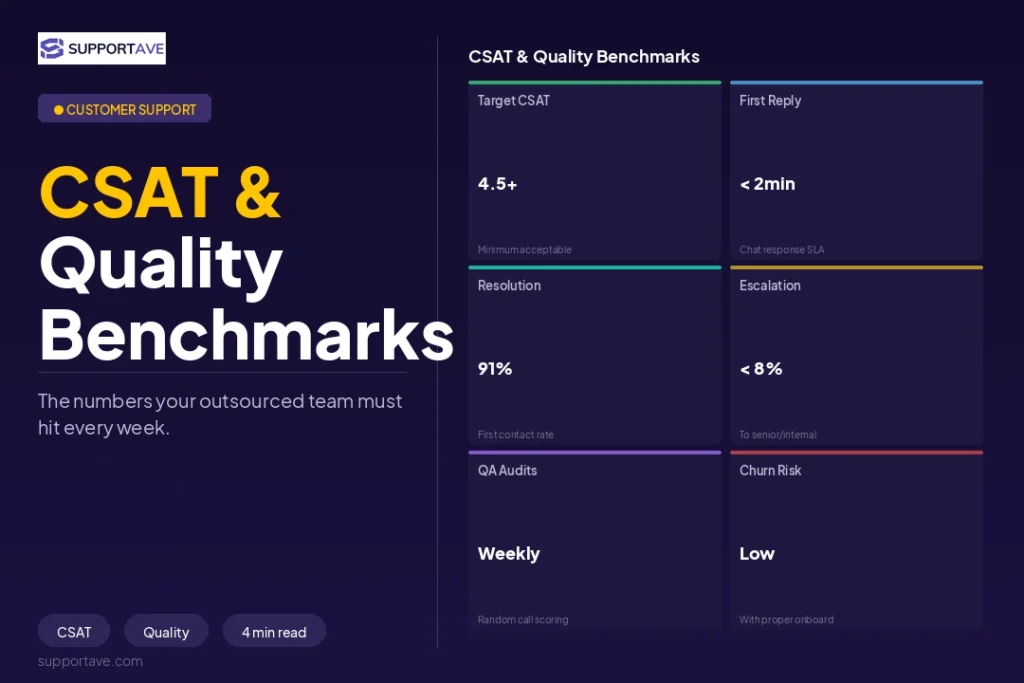
Standard SLAs for a professional BPO partner: first response time under 2 hours for email (under 1 minute for live chat), CSAT score of 85%+ (90%+ for premium providers), first-contact resolution rate of 75–85% for routine enquiries, and 99.9% uptime for agent availability during contracted hours. Ask any provider for their current average metrics across existing clients — not theoretical targets.
Supportave provides dedicated outsourced chat, email, call, and virtual assistant support trained in your brand voice and integrated into your existing tools. Learn more at supportave.com/website-chat-support or contact us at supportave.com/contact.