
What Is a Full-Stack Web Development Agency? (And Do You Need One?)
If you’ve started exploring web development options for your business, you’ve almost certainly encountered the phrase ‘full-stack.’ Agencies use it broadly, developers put it on every CV, and it shows up in procurement briefs with very different meanings. This article explains what a full-stack web development agency actually is, what a genuinely full-stack build covers, and how to decide whether that’s what your project needs.
Quick Answer: A full-stack web development agency handles both the frontend (everything users see and interact with) and the backend (servers, databases, APIs, and business logic) as a single unified service. According to Coderio’s 2026 full-stack business analysis, organisations that can integrate interface, logic, data, and deployment into one delivery model launch faster, adapt sooner, and manage technical risk more effectively. You need a full-stack agency when your project has both a presentation layer and a data or logic layer that must work together.
Frontend, Backend, and Full-Stack — The Actual Difference
Understanding what ‘full-stack’ means requires understanding what it covers.
The frontend is the client-side layer — everything a user sees and interacts with directly. In 2026, professional frontend development means React, Next.js, or Vue.js for component architecture; TypeScript for type safety; Tailwind or CSS Modules for styling; and careful attention to performance metrics like Largest Contentful Paint and Cumulative Layout Shift. If you’ve read our breakdown of Next.js vs WordPress, you’ll recognise that platform choice directly affects how frontend performance is achieved — Next.js delivers it structurally, WordPress requires constant optimisation discipline.
The backend is the server-side layer — application logic, databases, authentication, API integrations, and everything that happens between a user’s action and the data they receive in response. Node.js, Python (FastAPI, Django), Go, and Ruby on Rails are the dominant backend choices in 2026. The backend is invisible to users but entirely responsible for what the frontend can do.
Full-stack means owning both layers under one roof. A full-stack agency designs the database schema, builds the API layer, develops the frontend components that consume it, and deploys the entire system to production. The value is coordination: no handoff failures between separate frontend and backend teams, no blame-shifting when a bug crosses the layer boundary, no communication lag when a feature change touches both sides.
What a Full-Stack Development Engagement Actually Covers
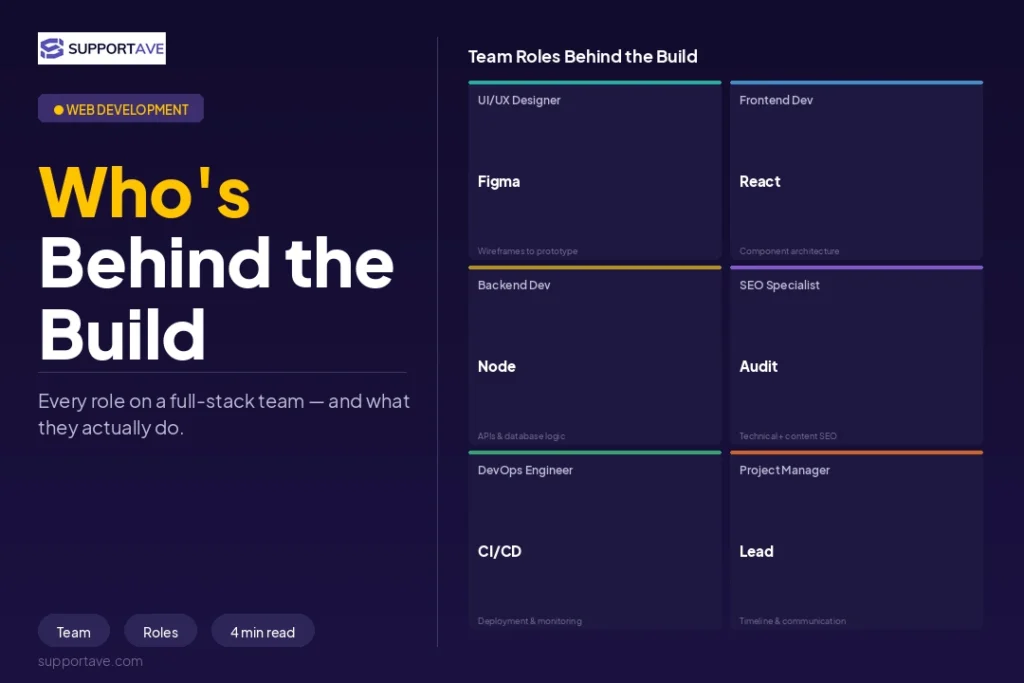
When you hire a full-stack web development agency, a professional engagement includes more than code. Here’s what the scope looks like in practice:
- Discovery and architecture: defining your data model, API design, third-party integrations, and deployment infrastructure before a single line of code is written. This is where scope gets locked — and where cutting corners costs the most later.
- Frontend development: pixel-perfect UI implementation, responsive layouts across devices, accessibility (WCAG 2.2 AA is the standard in 2026), animation, and performance optimisation.
- Backend development: business logic, authentication (JWT, OAuth 2.0), database design (PostgreSQL, MongoDB, or others depending on your data model), API endpoints, and server-side data processing.
- Third-party integrations: payment gateways, CRMs, ERPs, email service providers, analytics platforms — every integration adds development time and testing complexity.
- QA and testing: unit tests, integration tests, end-to-end tests using Playwright or Cypress, and manual QA rounds across browsers and devices. GitHub’s 2024 research found that over 97% of software teams had adopted AI coding tools — but the importance of human review to catch cross-layer defects has grown with it, not shrunk.
- DevOps and deployment: CI/CD pipelines, containerisation (Docker), cloud hosting on AWS or Vercel, zero-downtime deployments, monitoring dashboards, and automated backups.
- Post-launch support: bug fixes, performance monitoring, and feature iterations after launch. For details on what to expect in this phase, our guide on custom web development services covers the full post-launch lifecycle.
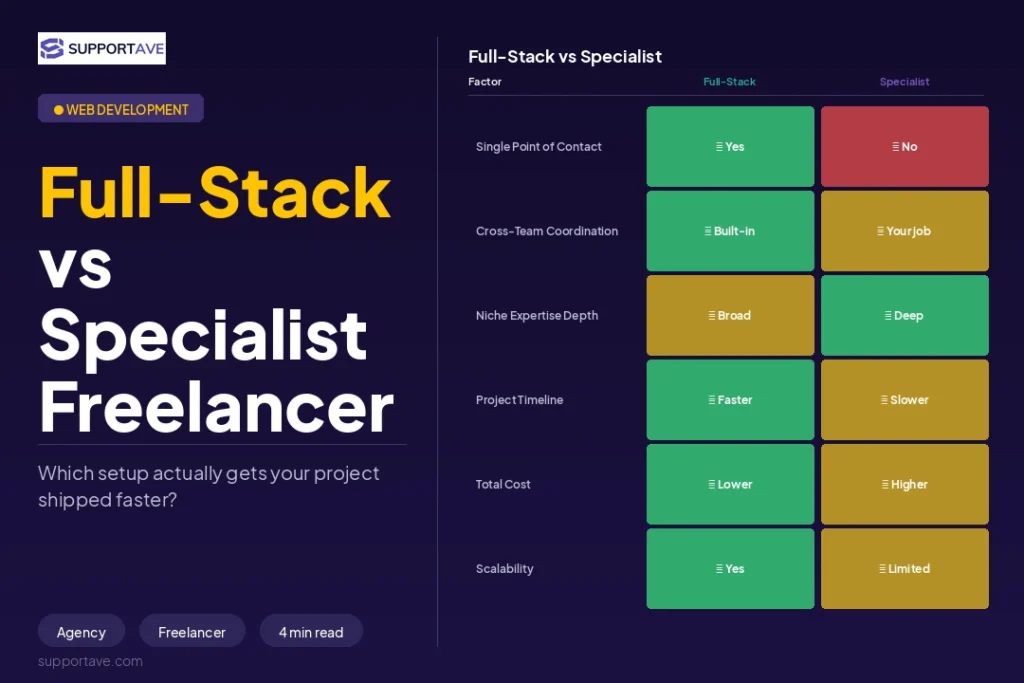
Full-Stack Agency vs Specialist Developers — When Each Makes Sense
| Factor | Full-Stack Agency | Specialist Teams (Frontend + Backend separate) |
| Best for | Most business websites, web apps, SaaS MVPs | Complex enterprise systems, large teams |
| Coordination | Single point of accountability | Risk of handoff failures between teams |
| Speed to delivery | Faster for most projects | Can be faster at enterprise scale |
| Cost | Higher than a freelancer; structured | Higher overhead across multiple vendors |
| Risk profile | Lower — one team owns the outcome | Higher — finger-pointing when bugs cross layers |
| Communication | One shared project board and update cadence | Multiple channels, multiple stakeholders |
The strongest full-stack team model in 2026, according to Coderio’s analysis, is a squad of 3–6 full-stack engineers owning a specific business capability, with embedded QA and a clear deployment owner responsible for CI/CD pipelines and monitoring. This structure suits most business projects better than splitting frontend and backend across two separate vendors.
Technology Stacks a Full-Stack Agency Uses in 2026
The specific stack matters less than whether it fits your requirements. Common combinations:
- MERN: MongoDB, Express.js, React, Node.js — popular for data-intensive applications and startups that need JavaScript across both layers.
- Next.js + PostgreSQL + Node.js — increasingly the default for business websites that need SSR/SSG performance with a relational database.
- Python (FastAPI or Django) + React — common in AI-adjacent products, data platforms, and businesses with existing Python infrastructure.
- WordPress headless + Next.js — the hybrid approach for content-heavy sites that need editorial simplicity and engineering performance. Our Next.js vs WordPress comparison covers exactly when this hybrid model makes sense versus a clean Next.js build.
A full-stack agency should recommend a stack based on your requirements — not the one they find most convenient. If an agency defaults to the same technology regardless of context, that’s a limitation, not a specialty.
Do You Actually Need a Full-Stack Agency?
Not every project does. Here’s how to assess your actual requirements:
You need a full-stack agency if:
- Your project involves users creating accounts, storing data, processing payments, or any server-side business logic.
- You need custom integrations with third-party APIs — CRMs, payment processors, ERPs, or authentication providers.
- You’re building a web application (SaaS product, marketplace, internal tool) rather than a content-only website.
- Your site has complex dynamic behaviour — real-time updates, personalisation, role-based access, or transaction processing.
- You need a single team accountable for the complete product, not multiple vendors managing separate layers.
A frontend agency or freelancer may be sufficient if:
- You need a marketing or brochure website without user accounts or server-side data processing.
- You’re extending an existing backend and only need frontend implementation.
- Your stack is already defined and you need component development within it.
Practical test: Ask yourself whether your product requires a database. If users submit data, log in, make purchases, or see personalised content — you have a backend requirement. If the site is static content with a contact form handled by a third-party service like Formspree, a frontend build may be sufficient. Most business websites in 2026 need at least some backend capability.
What Full-Stack Development Costs in 2026
Costs scale with scope, not platform. Typical ranges for professional full-stack builds:
- Simple web application or business site with basic backend (user auth, contact form processing, CMS): $10,000–$30,000.
- Mid-complexity SaaS MVP (user accounts, subscription billing, dashboard, API integrations): $40,000–$100,000.
- Complex platform (marketplace, enterprise system, multi-tenant SaaS): $100,000–$300,000+.
These ranges sit above what we covered in our website cost guide for simple brochure sites — because full-stack builds involve significantly more architecture, testing, and infrastructure than a front-facing marketing website. The overhead is real and is what you’re paying for: one team, one architecture, one accountable partner.
Red Flags When Evaluating a Full-Stack Agency
- They can’t describe their testing process in detail. A full-stack build without automated testing will cost you far more in bug fixes and delays than any initial saving.
- Junior developers handle all day-to-day work while senior staff only appear in sales calls. Ask to meet the project lead and lead developer before signing.
- They can’t explain which tech stack they’d recommend for your specific requirements and why. Platform-agnostic recommendations are the sign of genuine expertise.
- No fixed-scope discovery phase. Projects without a locked scope before build begins almost always run over budget and timeline.
- Vague post-launch support. Ask specifically what’s included, what response time looks like, and what the retainer arrangement covers after the initial launch period.
Frequently Asked Questions
What does ‘full-stack’ mean in plain language?
Full-stack refers to the complete technical scope of a web product — the frontend (what users see), the backend (servers, databases, APIs), and the infrastructure layer (hosting, deployment, monitoring). A full-stack developer or agency can build and manage all three. A specialist developer typically owns one layer deeply. Full-stack doesn’t mean doing everything — it means having the capability to own the complete technical output without needing to hand off between separate teams.
Is a full-stack agency the same as a digital agency?
Not always. A digital agency typically covers marketing, design, branding, and digital strategy — and may include web development as part of its service mix. A full-stack web development agency is specifically focused on the technical build: frontend and backend development, infrastructure, and integration. Some agencies do both. When evaluating a provider, ask specifically what their development team size is and whether development is their core competency or a supporting service.
How long does a full-stack project typically take?
Timeline depends entirely on scope. A business website with basic backend capability (contact form processing, a CMS, user authentication for an admin panel) typically takes 6–12 weeks. A SaaS MVP with subscription management, user dashboards, and API integrations typically runs 3–5 months. Complex platforms with multiple user roles, third-party integrations, and custom reporting start at 6 months. Tight timelines can be achieved but generally cost 20–50% more in engineering overhead.
Can I hire a full-stack agency for an ongoing retainer instead of a fixed project?
Yes — and for many businesses this is the better model. A monthly retainer gives you continuous access to the team for feature development, bug fixes, performance improvements, and infrastructure management, without needing to scope and sign a new contract for every change. Retainers typically run $3,000–$15,000/month depending on the agency and the level of commitment. For businesses with actively evolving digital products, a retainer model reduces the overhead of repeated procurement and keeps the team deeply familiar with your codebase.
What should I prepare before my first meeting with a full-stack agency?
Three things: a clear description of what the product needs to do (user stories or a feature list is ideal), examples of products you admire technically or functionally, and your honest budget range and timeline. You don’t need a technical specification — a good discovery process will produce one. But having specific business goals, a defined user journey, and awareness of your constraints makes the first conversation far more productive and produces more accurate proposals.
Supportave is a full-service digital agency covering web development, digital marketing, and customer support outsourcing. Our web development team builds across React, Next.js, Node.js, Python, and AWS — see our web development services or get in touch to discuss your project.