
TikTok Ads vs Instagram Ads: Where Should You Spend in 2026?
The paid social landscape in 2026 has two dominant short-form video platforms and a budget that doesn’t stretch across both equally. TikTok and Instagram both offer massive reach and sophisticated ad tools, but they serve fundamentally different user mindsets and reward completely different creative approaches. If you’ve already read our Google Ads vs Meta Ads comparison, you’ll know that platform choice should be driven by where your customer sits in the buying journey — the same principle applies when comparing these two social platforms.
Quick Answer: TikTok delivers stronger ROI for awareness, discovery, and top-of-funnel reach — especially for audiences under 35. Instagram delivers stronger ROI for conversion, retargeting, and campaigns that depend on purchase intent and mature shopping infrastructure. For most businesses with the budget to run both, TikTok creates demand and Instagram captures it. The mistake is running the same creative on both platforms and expecting the same result.
The Fundamental Difference: Discovery vs Curation
Before looking at any numbers, understand the user mindset on each platform. According to TikTok for Business, 56% of users open TikTok specifically to discover something new. They are scrolling with an open mind, not a shopping list. The algorithm serves them content based on interest signals, not who they follow — which means an unknown brand with great creative can reach millions with zero ad spend history on the platform.
Instagram users are in curation mode. They follow accounts they’ve chosen, browse content from people they know, and have a more established relationship with brands they’ve already encountered. The platform’s ad retargeting infrastructure — built on Meta’s Conversions API and Pixel data — is mature and reliable. Users are closer to a purchase decision when they see your ad, which is why Instagram consistently outperforms TikTok on bottom-of-funnel conversion metrics.
This isn’t a weakness of either platform — it’s a design difference. Neither one is ‘better.’ They do different jobs.
Cost Benchmarks: What You’ll Actually Pay in 2026
| Cost Metric | TikTok Ads | Instagram Ads |
| Average CPM | $4.20 – $9.16 | $6 – $15 |
| Average CPC | $0.17 – $1.00 | $3 – $5 |
| Minimum daily budget (ad group) | $20/day | $1/day |
| Minimum campaign budget | $50/day | No campaign-level minimum |
| Creative fatigue cycle | 5–7 days (fast) | 2–4 weeks (slower) |
| ROAS benchmark | $4.13 per $1 spent (avg) | $3.21 per $1 spent (avg) |
| Engagement rate (2025 benchmark) | 3.70% | 0.48% |
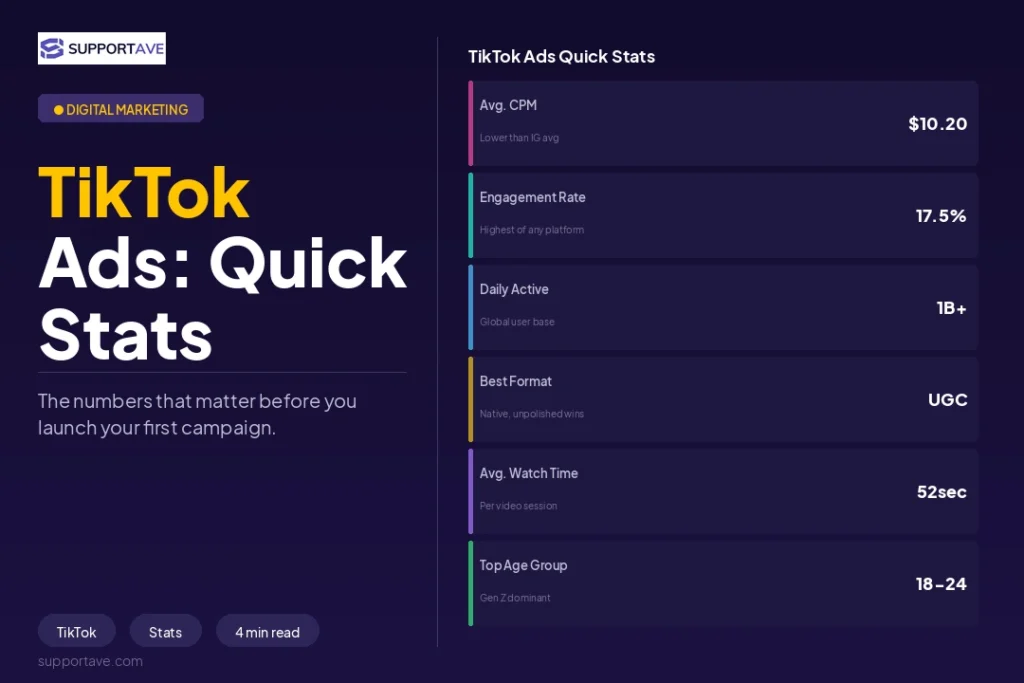
TikTok is 20–40% cheaper per impression than Instagram across most objectives, according to Gupta Media’s 2025 CPM tracker (Instagram averaged $8.58 CPM in January 2025 versus TikTok’s $4.20 in the same period). But the cost comparison is misleading without context: TikTok’s minimum campaign budget is $50/day — significantly higher than Instagram’s — and TikTok’s rapid creative fatigue cycle means you spend significantly more on creative production to maintain performance.
Real cost warning: TikTok ads return an average of $4.13 for every $1 spent versus Instagram’s $3.21 (source: Affninja’s 2026 advertiser analysis across their platform). But these averages mask wide variance. TikTok’s engagement rate of 3.70% is more than seven times Instagram’s 0.48% (Socialinsider’s 2026 benchmark of 70 million posts) — but engagement does not automatically translate to conversion.
Creative Requirements: The Real Differentiator
This is where the practical difference between platforms becomes most stark — and where most businesses make the most costly mistake.
TikTok: Native or Nothing
TikTok’s multi-modal AI reads your video content — colours, text overlays, the first two seconds of motion — to determine who should see it. Polished, TV-style commercials are actively penalised by the algorithm because they look like ads, and TikTok users scroll past them instantly. The winning format is creator-native: unpolished, authentic, hook-first, sound-on. UGC-style native ads deliver 30–40% lower CPMs than polished brand commercials on TikTok. Creative fatigue arrives in 5–7 days for most ad creatives, which means you need a constant production pipeline, not a quarterly campaign.
Ray-Ban’s TikTok campaign using AI-driven Smart+ Catalog Ads — prioritising authentic creative over studio production — achieved a 50% decrease in cost per acquisition, a 47% improvement in conversion rate, and a 42% higher ROAS, according to TikTok for Business case study data.
Instagram: Polish Signals Premium
Instagram’s visual culture rewards quality. The platform’s audience expects well-composed images, produced Reels, and creative that matches the aesthetic standard of the accounts they choose to follow. Low-production-quality ads can work on Instagram when they carry strong social proof (UGC testimonials, before/after formats), but the threshold for ‘looks intentional’ is higher than TikTok.
Instagram also offers format diversity that TikTok doesn’t match: Reels for video reach, Stories for time-sensitive offers, carousels for product showcases or educational content, and static posts for brand image. This variety gives advertisers more strategic flexibility within a single platform.
Audience Demographics: Who’s Actually There
The old narrative that TikTok is only for teenagers is out of date. As of late 2025, Statista reports TikTok’s largest demographic as males aged 25–34, and the platform has 1.99 billion monthly active users. Instagram has approximately 2 billion monthly users with a stronger 25–44 demographic skew — an audience with higher average income and more established purchase behavior.
The practical implication: if your primary customer is under 30, TikTok’s reach is unrivalled and the ad costs are still lower than they will be in 12 months (TikTok CPMs are forecast to rise 14–22% during 2026 as more DTC, SaaS, and service advertisers enter the auction). If your primary customer is 30–50 and has disposable income for your product category, Instagram gives you a more qualified demographic at a higher but justified cost.
When TikTok Wins
- Your product is visually demonstrable or has a ‘wow factor’ that plays well on video — fashion, beauty, fitness equipment, food, gadgets.
- You are building brand awareness with a new audience that has never heard of you.
- Your target customer is under 35 and is not yet in active search mode for your category.
- You have the capacity to produce 4–6 short video creatives per month sustainably.
- You want the lowest CPM for top-of-funnel reach in your industry.
When Instagram Wins
- You are retargeting users who have already visited your website, watched a video, or engaged with your brand.
- Your product is high-consideration — customers need to see it multiple times across different contexts before purchasing.
- Your customer demographic is 30–50, professional, or has a higher income level.
- You need seamless integration with a Shopify store via Instagram Shopping.
- Your creative assets are polished and you have strong existing brand photography.
These patterns align with what we covered in our complete Google Ads vs Meta Ads breakdown — the bigger principle is that platform selection should match funnel stage, not trend.
Budget Allocation Framework for 2026
| Business Scenario | Recommended Split | Rationale |
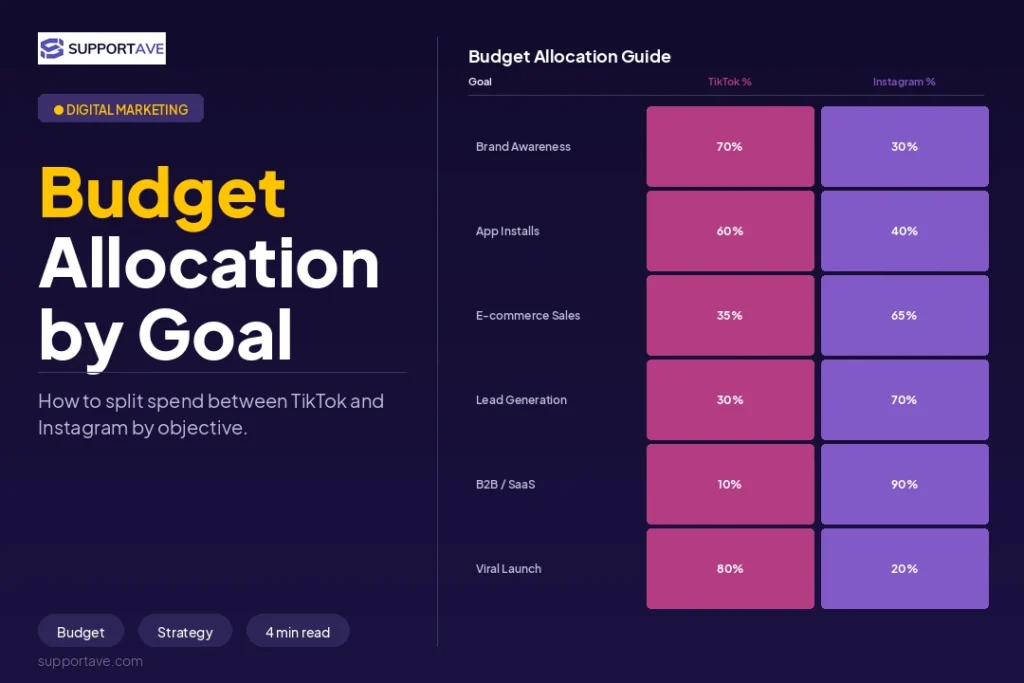
| E-commerce — visual product, new brand | 60% TikTok, 40% Instagram | Discovery first; Instagram retargets site visitors |
| E-commerce — established brand, retargeting | 30% TikTok, 70% Instagram | Instagram closes; TikTok refreshes awareness |
| B2B / professional services | 10% TikTok, 90% Meta/Instagram | B2B buyers don’t convert from TikTok discovery |
| SaaS product — young professional audience | 50/50 | TikTok for awareness; Instagram for trial signup push |
| Local service business | TikTok only or Meta only (not both) | Budget too small to split; pick your audience’s platform |
| Budget under $1,500/month | One platform only | Prove ROI before splitting data thin |
Key rule: With budgets under $1,500/month, focus on one platform and prove ROI before splitting. Meta’s minimum learning phase requires approximately 50 conversion events per week per ad set — spreading budget across two platforms with a small spend means neither platform has enough data to optimise meaningfully. This same principle applies when comparing
Tracking and Attribution: What You Need Set Up Before Spending
Both platforms face attribution challenges from iOS App Tracking Transparency. TikTok’s Events API (CAPI) and Meta’s Conversions API both address this by sending conversion data server-side rather than via the browser. Before you spend on either platform, ensure both pixels are correctly installed and your server-side API is configured. For step-by-step guidance on conversion tracking specifically for Meta campaigns, our guide on fixing Meta Ads mistakes covers the exact steps for implementing CAPI and verifying your pixel is firing correctly.
Without proper tracking, you are not optimising either platform — you are spending based on incomplete data and making budget decisions you cannot justify.
Frequently Asked Questions
Is TikTok still worth advertising on given regulatory uncertainty?
Yes — but with a sensible approach to platform risk. TikTok has faced regulatory scrutiny in the US and some European markets. The practical response is not to avoid it but to avoid over-concentration: don’t put 100% of your paid social budget on TikTok while regulatory status is unresolved. A 40–60% allocation alongside Instagram gives you access to TikTok’s CPM efficiency without existential exposure to a platform shutdown.
Do I need a separate creative strategy for each platform?
Absolutely, and this is one of the most common budget-wasting mistakes. Repurposing polished Instagram creative for TikTok typically results in 30–50% worse performance than platform-native content. At minimum, reformat and re-edit content to match platform norms: crop ratios (9:16 for both, but TikTok expects text overlays and dynamic pacing), audio-on assumption on TikTok versus often sound-off on Instagram Stories, and hook structure (TikTok needs the hook in the first 2 seconds; Instagram Reels can afford a 3–5 second build).
What is TikTok Search Ads and should I be using them?
TikTok Search Ads allow you to bid on keywords and appear when users search within TikTok — a growing behaviour, particularly among Gen Z who use TikTok as a discovery search engine rather than Google. Nearly 40% of young users prefer TikTok for discovering products, restaurants, and services. TikTok Search Ads carry higher purchase intent than For You feed placements because the user is actively looking. If your product category has search volume on TikTok (beauty, food, travel, fitness, local services), Search Ads are worth testing alongside standard In-Feed placements.
What budget do I need to start seeing results on TikTok?
To get the algorithm out of the learning phase and see stable, optimisable performance, plan for $1,500–$2,000/month as a starting monthly budget. The platform minimum is $20/day at the ad group level and $50/day at the campaign level — but at those minimums, data accumulates too slowly for meaningful optimisation. Additionally, budget 15–20% of your media spend for creative production (video editing, UGC production) — TikTok’s creative fatigue cycle means production is an ongoing cost, not a one-time investment.
Can a small business compete on TikTok against large brands?
More effectively than on most other platforms. TikTok’s algorithm prioritises content quality over advertiser spend history — a small brand with genuinely useful, entertaining, or authentic video can outperform a major brand running overproduced commercials. For context, Konesso, a premium coffee e-commerce brand, ran organic-style content as ads and achieved an 80.4% increase in revenue and a 77.6% increase in transactions (TikTok for Business case study). Budget does not override creative quality on TikTok.
Supportave manages paid advertising across TikTok, Instagram, Google, and LinkedIn — including creative strategy, campaign setup, and performance reporting. See our digital marketing services or contact us to discuss your paid social strategy.