
React vs Next.js vs WordPress: Which Platform Is Right for Your Business in 2026?
Three names dominate every web development conversation in 2026: React, Next.js, and WordPress. They’re frequently discussed as if they’re interchangeable competitors, but they actually occupy different layers of the same stack — and understanding that distinction is the key to choosing correctly. This guide breaks down what each one actually is, where each wins, and gives you a clear framework for deciding. If you’ve read our Next.js vs WordPress deep dive, this article adds the third piece of the puzzle: where raw React fits into the decision.
Quick Answer: React is a JavaScript library for building user interfaces — it requires a framework like Next.js to become a complete website solution. Next.js is a production framework built on React that adds server-side rendering, routing, and SEO tooling. WordPress is a content management system that lets non-technical teams publish without code. For most business websites, Next.js is the modern default; for content-heavy sites with frequent non-technical publishing, WordPress remains the pragmatic choice; raw React alone is rarely the right choice for a complete website.
What Each Platform Actually Is
These three are not equivalent options on a menu — they sit at different levels of abstraction, and conflating them is where most confusion starts.
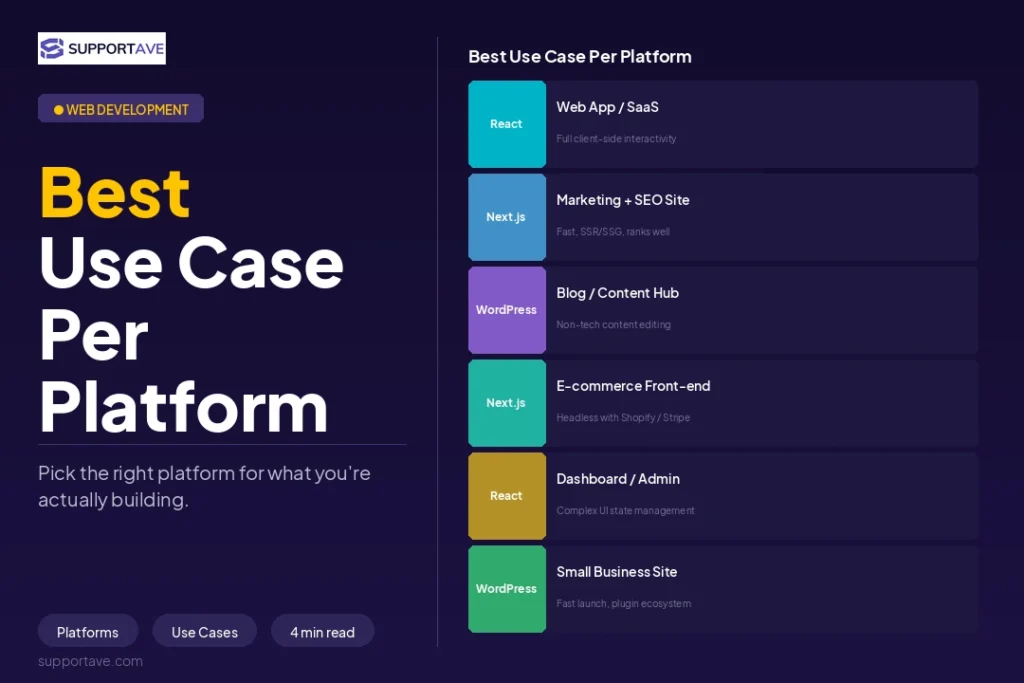
React: A UI Library, Not a Website Platform
React is an open-source JavaScript library created and maintained by Meta. It lets developers build interactive user interfaces using reusable components — but on its own, React provides no routing, no server rendering, no SEO tooling, and no deployment structure. According to NPK Media’s 2026 platform analysis, React currently powers around 4% of websites globally — a smaller number than you’d expect, precisely because most React-based sites are actually built with a framework on top of it. Using raw React for a full website means building all of that infrastructure yourself, which is why almost nobody does it for production business sites.
Next.js: React, Production-Ready
Next.js is a framework built on top of React by Vercel. It solves the problems raw React leaves open: server-side rendering (SSR), static site generation (SSG), file-system-based routing, automatic code splitting, built-in image optimisation, and a metadata API for SEO. When people say they’re ‘building in React’ for a business website in 2026, they almost always mean Next.js. It’s the production-grade way to use React.
WordPress: A Complete CMS
WordPress is a content management system — software that handles content storage, an editing interface, user accounts, and page rendering as one integrated package. It powers approximately 43% of the web, according to multiple 2026 market share reports. Unlike React and Next.js, WordPress doesn’t require JavaScript knowledge to operate day-to-day; the entire value proposition is that non-technical teams can publish and manage content independently.
Performance: The Numbers That Matter in 2026
Page speed is a confirmed Google ranking factor through Core Web Vitals, and the performance gap between these platforms is structural, not incidental.
| Metric | Raw React (SPA) | Next.js | WordPress |
| Typical mobile PageSpeed | 40-70 (varies hugely) | 85-98 | 45-60 average |
| Initial load method | Client-side rendering | Server-rendered + static | Server-rendered (PHP) |
| SEO crawlability out of the box | Poor (needs extra work) | Excellent | Good (with plugins) |
| Core Web Vitals pass rate | Variable, often weak | Strong by default | 44% pass on mobile |
| Caching requirement | Manual setup needed | Built-in (ISR, SSG) | Requires plugins (WP Rocket etc.) |
A standard WordPress site with a popular theme and 8-12 active plugins on shared hosting typically scores in the 45-60 range on Google Lighthouse, according to STEVEN STUDIO’s 2026 benchmark data. A comparable Next.js site deployed on Vercel with SSR and image optimisation regularly scores 90+. Raw React single-page applications can score anywhere in between, heavily dependent on how much performance engineering the development team has done manually — this inconsistency is exactly why frameworks like Next.js exist.
Why this matters financially: Amazon found that every 100ms of added load time cost them 1% in sales. For a business generating leads online, the platform’s default performance ceiling directly affects revenue — not just rankings.
SEO: Built-In vs Bolted-On
WordPress makes basic SEO accessible to non-technical users through plugins like Rank Math or Yoast — meta tags, sitemaps, and readability scoring, all from a dashboard. This is genuinely valuable for content teams. The structural weakness, as we explored in our Next.js vs WordPress comparison, is that this capability depends on third-party plugins staying compatible and updated.
Next.js handles SEO at the code level: meta titles, Open Graph images, canonical URLs, and JSON-LD structured data are implemented through its built-in Metadata API — version-controlled and not subject to plugin conflicts. Server-rendered HTML means Googlebot reads fully-rendered content immediately, without relying on JavaScript execution.
Raw React applications, when built as client-side single-page apps without a framework, present the weakest SEO foundation of the three. Search engines have to execute JavaScript to see content, which historically caused indexing problems — and while Google’s crawler has improved at this, it remains a meaningfully worse starting position than either Next.js or WordPress.
Cost of Ownership Over 3 Years
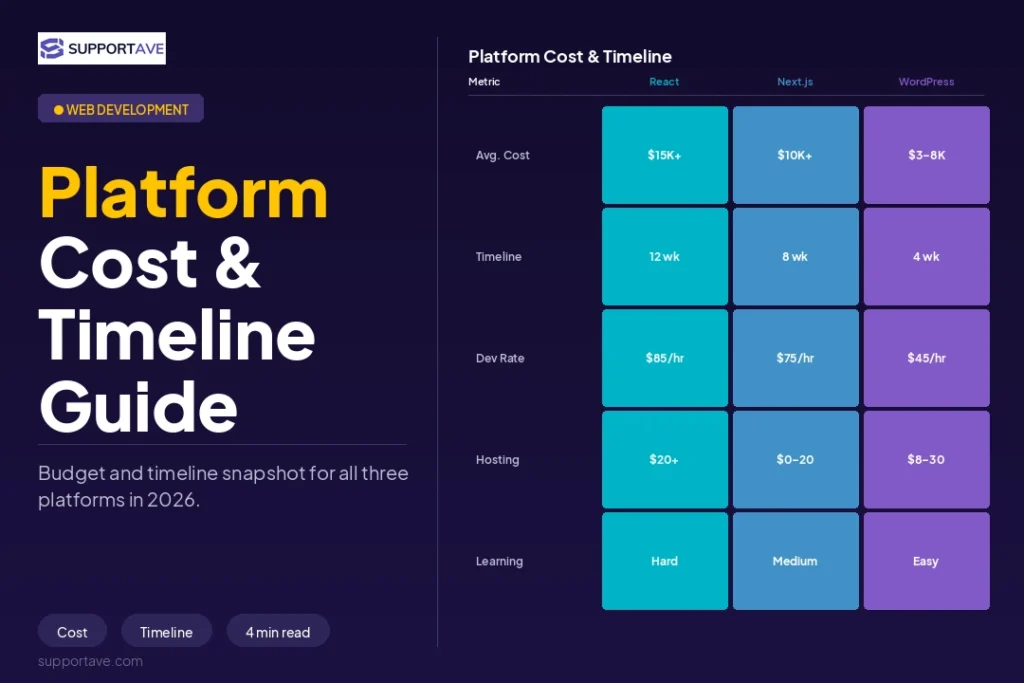
| Cost Category | Raw React (custom build) | Next.js + Headless CMS | WordPress |
| Initial build | $15,000-$40,000+ | $8,000-$25,000 | $3,000-$15,000 |
| Hosting (3yr) | $1,000-$5,000 | $0-$7,200 (Vercel) | $720-$5,400 |
| Plugin / licence costs | None (custom code) | None (NPM packages) | $600-$6,000 |
| Ongoing dev maintenance | High — custom infra | Low — minimal patching | Moderate-high — updates/conflicts |
| Typical 3-year total | $25,000-$60,000+ | $10,000-$40,000 | $10,000-$50,000+ |
Raw React custom builds carry the highest total cost because every piece of infrastructure that Next.js or WordPress gives you by default — routing, SEO, caching, deployment pipelines — has to be engineered from scratch. This is rarely justified for a standard business website; it only makes sense when you need extremely specific architectural control that no framework provides.
Content Management: Where WordPress Still Wins
This is the genuine, durable advantage WordPress holds. Gutenberg (its native block editor) lets marketing teams publish blog posts, update pages, and manage media without any developer involvement. For businesses publishing frequently — and if you’re running a structured 30-day blog content calendar like the one we build for clients, this matters enormously — that publishing independence has real operational value.
Next.js requires a headless CMS (Sanity, Contentful, or Payload are the most common 2026 choices) for non-technical editing. Once configured by a developer, these tools provide a publishing experience that matches or exceeds WordPress — but that configuration is an upfront cost WordPress simply doesn’t have.
Raw React has no content management layer at all unless one is built or integrated. It is the least content-editor-friendly of the three by a wide margin.
Decision Framework
Choose WordPress if:
- Your team needs to publish content frequently without developer involvement
- Your budget is under $15,000 and the site is primarily content and brochure-style
- You need mature plugin functionality fast — booking systems, membership sites, WooCommerce
- Your traffic volume is moderate (under 100,000 monthly visits) where WordPress performance is manageable with good hosting
Choose Next.js if:
- Performance and Core Web Vitals scores are a competitive priority
- You’re building a web application with custom interactivity, not just a content site
- Long-term security and maintenance overhead matter — fewer plugins means a smaller attack surface
- You have access to React/JavaScript development resources, in-house or via an agency
Choose raw React (no framework) only if:
- You’re building a highly specific internal tool or dashboard with unusual architectural requirements
- You have a development team that genuinely needs to control every layer of rendering and routing manually
- This is rare for a public-facing business website — for most teams considering ‘React,’ Next.js is the better and more standard answer
The hybrid option: Headless WordPress — WordPress as the content backend, Next.js as the frontend — increasingly gives businesses both editorial simplicity and engineering performance. According to Freelancer Abhi’s 2026 client data, 70% of their new projects now use Next.js or this hybrid model precisely because it removes the trade-off.
Frequently Asked Questions
Is Next.js just React with extra features?
Functionally, yes — Next.js is built on top of React and uses React’s component model throughout. The difference is that Next.js adds everything needed to ship a production website: server-side rendering, routing, image optimisation, and SEO tooling. Choosing ‘React’ for a business website in 2026 almost always means choosing Next.js in practice, since building that infrastructure manually on raw React rarely makes sense outside specialised use cases.
Can WordPress be combined with React or Next.js?
Yes — this is called headless WordPress, and it’s an increasingly common approach in 2026. WordPress manages content through its familiar dashboard; a Next.js frontend fetches that content via the WordPress REST API or WPGraphQL and renders it as a high-performance site. This combines WordPress’s editorial strength with Next.js’s performance advantage, at the cost of additional setup complexity.
Which platform is cheapest to start with?
WordPress has the lowest initial cost — a theme and hosting can be live for under $500. However, the true cost over 3 years often favours Next.js once you account for WordPress’s ongoing plugin licences, security monitoring, and maintenance overhead. Raw React custom builds are consistently the most expensive option because they require building infrastructure that the other two provide by default.
Do I need to know JavaScript to use Next.js?
Yes, for building and modifying the site. End users and content editors don’t need JavaScript knowledge if a headless CMS is configured for them — but the underlying site requires a developer comfortable with React and JavaScript for any structural changes. This is the core trade-off versus WordPress, where non-technical staff can make changes directly.
Will switching from WordPress to Next.js or React hurt my SEO?
A poorly planned migration can damage rankings temporarily. A well-planned one — with comprehensive 301 redirects, preserved content, and correct metadata migration — typically improves rankings within 60-90 days as Google re-evaluates the site’s improved Core Web Vitals scores. The technical SEO ceiling is higher with Next.js; the migration risk is managed through careful execution, not by avoiding the move.
Supportave builds on WordPress, Next.js, and custom React stacks — and recommends the platform that fits your actual requirements, not our convenience. See our web development services or get in touch to discuss which platform is right for your project.