
Custom Web Development Services: What You Actually Get (And What to Ask For)
Most businesses discover the hard truth about web development after they have already signed a contract: the deliverables were not what they imagined. Custom web development services cover a wide spectrum — from a five-page marketing site to a multi-tenant SaaS platform — and the gap between those two things is enormous. This guide explains exactly what professional custom web development includes, how projects are scoped and priced in 2026, and what questions to ask any agency before committing a single dollar.
Quick Answer: Custom web development services involve building a website or web application designed specifically for your business requirements — no shared templates, no generic layouts. A professional agency handles design, frontend, backend, third-party integrations, testing, and deployment. In 2026, costs range from $3,000 for a simple business site to $150,000+ for enterprise platforms, with timelines typically spanning 4 to 28 weeks depending on scope.
What ‘Custom’ Actually Means in 2026
The word ‘custom’ gets used loosely. In practice, it refers to work that is built around your specific goals, audience, and business logic — not adapted from a prebuilt theme or page-builder template.
There are three levels of customisation you will encounter:
• Template-customised: A prebuilt theme (WordPress, Shopify) with colour, font, and content changes. Fast and affordable, but limited in layout flexibility and scalability.
• Semi-custom: A framework like React or Next.js is used, but components and design systems are drawn from existing libraries. A middle ground between speed and uniqueness.
• Fully custom: Every component — UI, architecture, database schema, API layer — is purpose-built for your product. This is true custom development, and it is what agencies like Supportave deliver for complex digital products.
Understanding which tier you need is the first conversation worth having with any development partner.
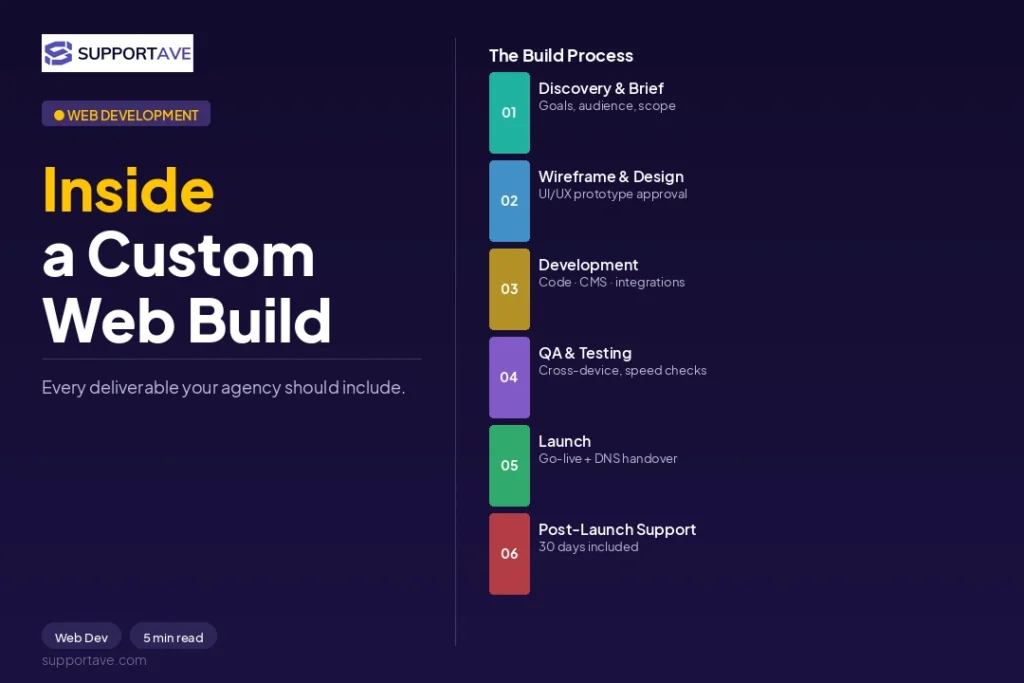
The Six Core Services Inside Every Custom Web Build
A professional engagement does not just mean someone writes code. It includes a structured set of disciplines that work together to ship a product that performs.
1. Frontend Development
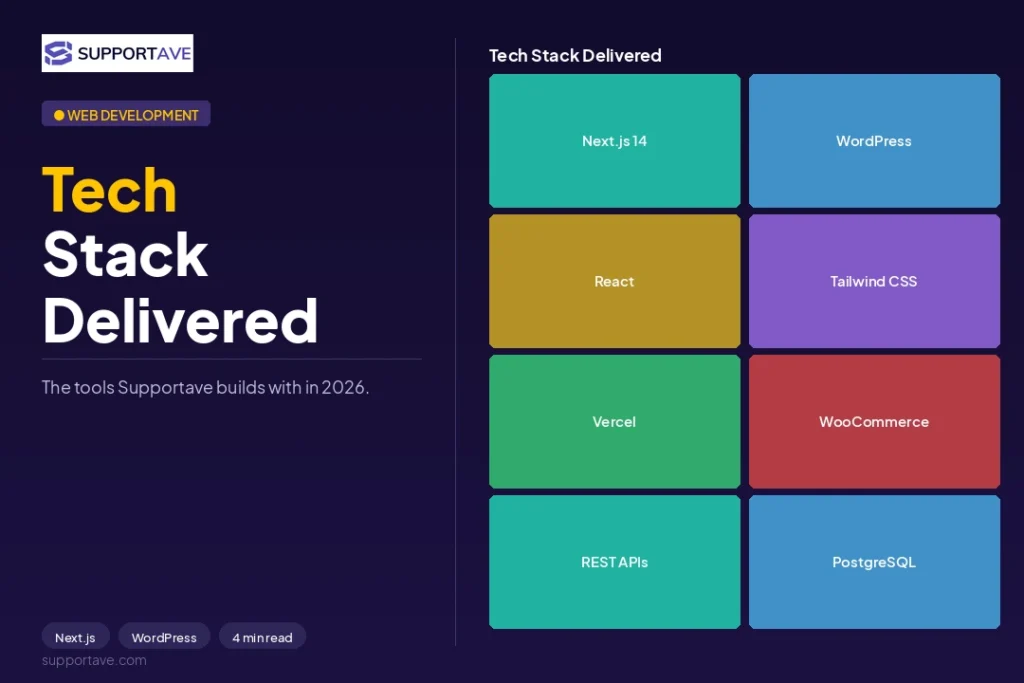
Frontend developers build everything a user sees and interacts with. In 2026, this means React, Next.js, and TypeScript for the component layer, combined with performance-first CSS using Tailwind or CSS Modules. Expect pixel-perfect designs, mobile-first layouts, smooth animations, and sub-2-second load times baked in from day one — not bolted on at the end.
2. Backend Development and APIs
The backend handles business logic: user authentication, data storage, server-side processing, and third-party integrations. Node.js, Python (FastAPI), and Go are the dominant choices in 2026. A solid backend is invisible to users but essential for anything that involves accounts, payments, real-time features, or data.
3. Database Design
Poor database design is the hidden cause of most scalability failures. Professional agencies define your schema, choose between relational (PostgreSQL, MySQL) or document-based (MongoDB) storage based on your data model, and index correctly from the start — saving expensive refactors later.
4. QA and Testing
Quality assurance means your project is tested across browsers, devices, screen sizes, and edge cases before it ships. This includes unit tests, integration tests, end-to-end tests using Playwright or Cypress, and manual QA rounds. Skipping this phase is how bugs reach production.
5. Deployment and DevOps
Deployment is not just uploading files. A professional setup includes CI/CD pipelines, containerisation with Docker, cloud hosting on AWS or Vercel, SSL configuration, automated backups, and monitoring dashboards. Zero-downtime deployments mean your users never see an error page during a release.
6. Post-Launch Support
The launch is the beginning, not the end. Reputable agencies include 30 days of post-launch support as standard, covering bug fixes, performance monitoring, and small adjustments as real user data comes in. Ongoing retainers handle feature development, security patches, and scaling as your business grows.
What Does Custom Web Development Actually Cost in 2026?
Pricing has never been more rational — or more variable. According to a 2026 Goodfirms survey of 300+ web development firms across 31 countries, 63% of agencies quote between $1,000 and $15,000 for standard projects. But enterprise builds regularly reach $150,000 and beyond.
| Project Type | Typical Cost Range | Typical Timeline |
| Small business website (5-15 pages) | $3,000 – $15,000 | 4-8 weeks |
| Corporate website (20+ pages) | $8,000 – $30,000 | 6-14 weeks |
| Custom e-commerce store | $15,000 – $75,000 | 8-20 weeks |
| SaaS / web application (MVP) | $50,000 – $150,000 | 3-6 months |
| Enterprise platform | $150,000+ | 6-12+ months |
Important: According to Clutch’s 2026 pricing data, the average agency project runs approximately $66,500 with a timeline of around 9 months. The most common budgeting mistake is comparing quotes without normalising for scope.
AI coding assistants have compressed development timelines by 22-34% per Goodfirms 2026 benchmark data, yet average project budgets have held steady or increased slightly. The reason: client expectations have risen at the same pace as tooling capability. Faster code generation has not made projects cheaper — it has made more sophisticated projects feasible within the same budget.
Factors That Push Projects Over Budget
The four factors that most reliably inflate a web development budget:
4. Scope creep: Features added mid-project that were not in the original statement of work. Fixed-scope contracts and detailed discovery phases exist precisely to prevent this.
5. Third-party integrations: Every API integration — payment gateways, CRMs, ERPs — adds development time, testing complexity, and often ongoing maintenance. Budget $2,000-$10,000+ per significant integration.
6. Rush timelines: Per agency data, projects delivered faster than a standard timeline cost 20-50% more. A $20,000 project on a standard timeline can realistically reach $25,000-$30,000 when compressed.
7. AI integration: Adding LLM-powered features — chatbots, recommendation engines, voice AI — typically adds 15-30% to a project budget. Specialised AI engineering time and API costs are the main drivers.
15 Questions to Ask Before You Hire a Web Development Agency
• What does your discovery process look like, and how is scope locked before build starts?
• Can I see production code examples or a technical portfolio — not just design screenshots?
• Who exactly will work on my project — senior developers or juniors managed by seniors?
• How do you handle changes to scope mid-project?
• What is your QA process, and do you use automated testing?
• What deployment pipeline do you use, and how are rollbacks handled?
• What does post-launch support include, and what does it cost after the included period?
• How do you approach performance — what PageSpeed scores do your recent projects achieve?
• Who owns the code, assets, and infrastructure when the project ends?
• How do you ensure security — authentication, data encryption, vulnerability scanning?
• What is your communication cadence — daily standups, weekly updates, shared project board?
• Have you built in my industry before? What compliance requirements do you understand?
• What happens if the project runs over timeline — how is that communicated and managed?
• Can I speak with two or three recent clients?
• What does a typical handoff look like — documentation, training, credentials?
Pro Tip: Any agency that cannot give clear, specific answers to these questions is not the right partner. Vague answers to scope, ownership, and QA questions are the clearest signal of future problems.
How Supportave Approaches Custom Web Development
At Supportave, every project begins with a fixed-scope discovery phase: we audit your requirements, define deliverables with milestone timelines, and produce a statement of work before any build begins. We use React, Next.js, Node.js, Python, and AWS — and we have shipped 120+ projects across healthcare, fintech, AI, e-commerce, and education.
Our process includes weekly demos, a shared project board, and async updates so you are always in the loop. QA runs through the entire build, not just at the end. And every project includes 30 days of post-launch support as standard.
Frequently Asked Questions
How long does a custom website take to build?
Timeline depends on scope. A simple 10-page business website typically takes 4-8 weeks. A custom e-commerce platform usually needs 8-20 weeks. SaaS applications and complex web platforms can take 3-6 months or longer. According to Goodfirms 2026 data, 68% of professional web projects land between 8 and 28 weeks. Discovery and planning phases at the start save time overall by reducing mid-project rework.
What is the difference between a website and a web application?
A website primarily presents information — it is mostly static and does not require user accounts or complex logic. A web application is interactive and data-driven: users can log in, create content, manage accounts, or perform transactions. The line blurs for content-heavy sites with forms or membership areas, but the engineering complexity is the real distinguishing factor. Web apps require backend infrastructure, database architecture, and more extensive security planning.
Do I own the code after the project is complete?
With a reputable custom development agency, yes — you own all code, design assets, and infrastructure upon final payment. Always confirm this in writing before signing. Some agencies retain ownership of reusable internal libraries or third-party components, which is standard, but the code built for your project should be yours. Get this explicitly confirmed in the contract.
Can you build on an existing website or do you have to start from scratch?
Both are possible. Rebuilding from scratch makes sense when the existing codebase is too slow, outdated, or poorly structured to support future growth — a common issue with sites built on legacy WordPress stacks or early-version frameworks. Extending an existing codebase is faster and cheaper when the foundation is solid. A professional agency will conduct a technical audit before recommending an approach.
How much does ongoing website maintenance cost?
Ongoing maintenance typically costs 15-25% of the initial build cost per year. For a $10,000 website, that is $1,500-$2,500 annually. This covers hosting ($50-$500/month depending on traffic), security monitoring, plugin and dependency updates, performance tuning, and minor content updates. Monthly retainers typically range from $500-$3,000 per month according to Goodfirms 2026 market data.
What should I have ready before approaching a web development agency?
Before your first call, prepare: a clear description of what the site or app needs to do, examples of sites you like and dislike, a list of must-have features, your approximate budget range, and your target launch date. You do not need a finished design or a complete spec — a good discovery process will help you develop those. But having business goals and basic context ready makes the first conversation far more productive.
Ready to start a web development project? Contact Supportave at supportave.com/contact for a scoped discovery session.