
Google Ads vs Meta Ads in 2026: Which Drives Better ROI for Your Business?
Every business with a marketing budget eventually faces the same question: Google Ads or Meta Ads? The honest answer is that there is no universal winner — but there is a right answer for your business, your offer, and where your customers are in their buying journey. This comparison cuts through the platform hype to give you the data, the benchmarks, and a clear framework for deciding where your budget should go in 2026.
Quick Answer: Google Ads delivers stronger ROI when your customers are actively searching for what you sell — high purchase intent, faster conversion cycles. Meta Ads delivers stronger ROI when you need to build awareness, target by interest or behaviour, or sell visually compelling products. For most businesses, the best approach combines both: Meta creates demand, Google captures it.
The Fundamental Difference: Intent vs Discovery
The single most important distinction between Google Ads and Meta Ads is the mental state of the person your ad reaches.
Google Ads is intent-based advertising. When someone searches ‘best web development agency’ or ‘outsource customer support UK,’ they are not browsing — they are actively looking for a solution. Google captures that demand at the precise moment it exists.
Meta Ads is discovery-based advertising. Users on Facebook and Instagram are scrolling content, watching Reels, messaging friends. They are not searching. Your ad interrupts that flow and relies on creative, relevance, and repetition to generate interest in something they were not actively looking for.
| Factor | Google Ads | Meta Ads |
| User mindset | Actively searching | Passively browsing |
| Primary strength | Captures existing demand | Creates / expands demand |
| Best funnel stage | Bottom of funnel | Top and middle of funnel |
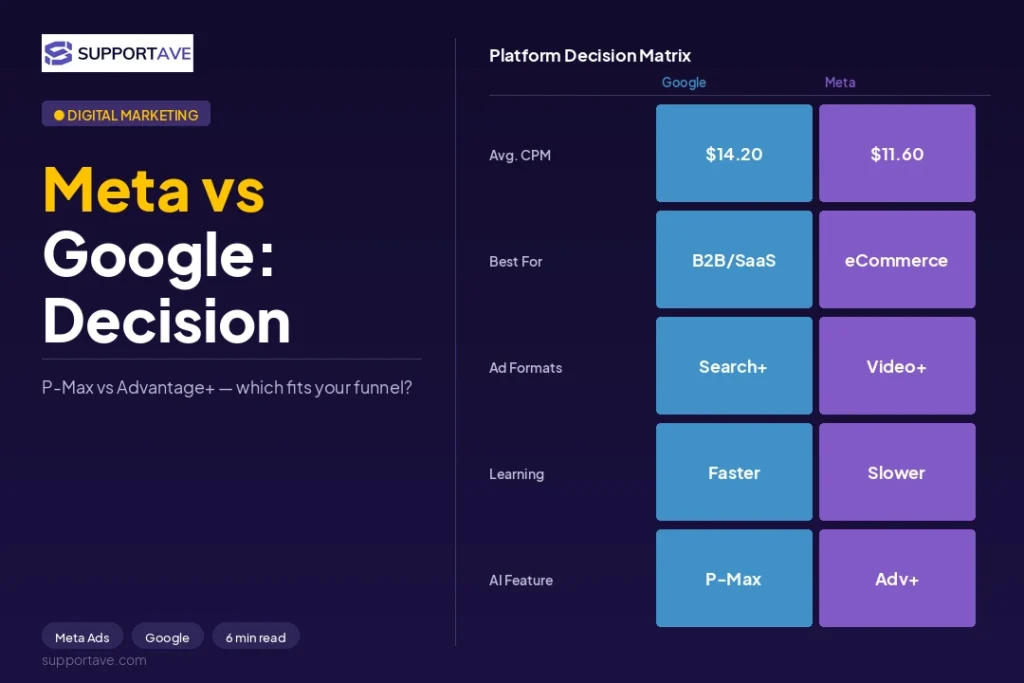
| Average CPC (2026) | $4.22 – $5.26 | $0.50 – $1.50 |
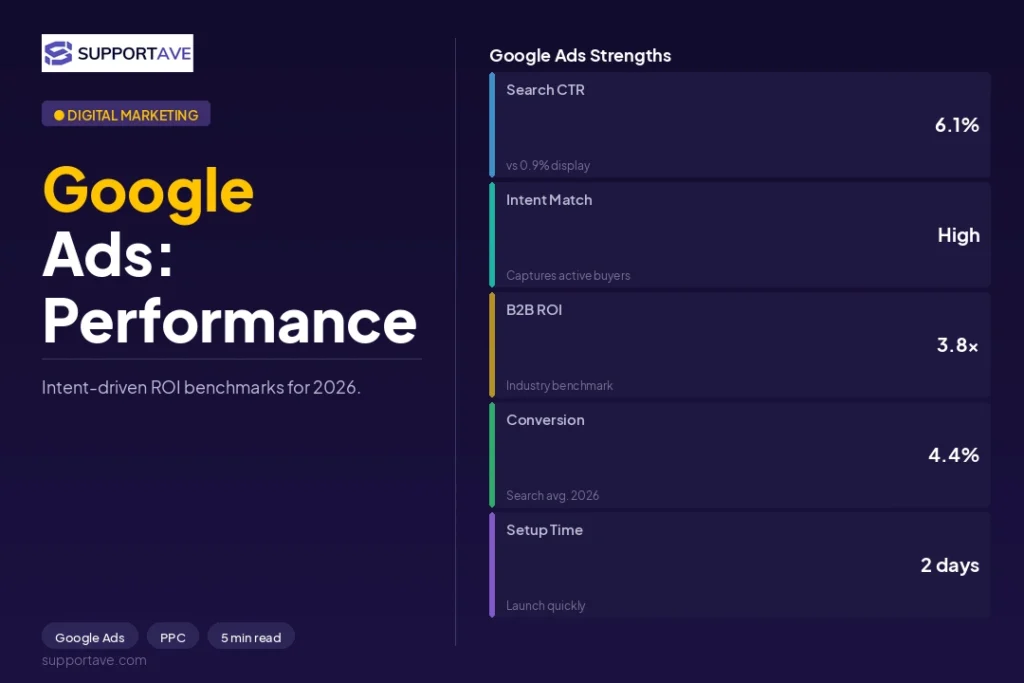
| Average conversion rate | ~3.75% | ~0.9% |
| Creative requirement | Strong copy | Strong visual + hook |
| Time to results | Days (with intent) | 2-6 weeks (optimisation) |
| B2B performance | Excellent | Moderate |
| E-commerce performance | Good | Excellent (visual products) |
The Numbers: CPC, Conversion Rate, and ROAS in 2026
Cost Per Click
Meta Ads cost 70-80% less per click than Google Ads. According to 2026 benchmarks, Meta averages $0.97 CPC while Google hits $4.22-$5.26 CPC. But cheaper clicks do not mean better results. Google’s higher CPC reflects higher commercial intent. A user who clicked a Google search ad for ‘custom web development services’ is further along the buying journey than someone who tapped a Meta ad in their Facebook feed while commuting.
Conversion Rate
Google Ads converts at approximately 3.75% on average. Meta Ads converts at approximately 0.9%. The platform charging four times more per click also delivers four times the conversion rate. The actual cost-per-acquisition is closer than the CPC comparison suggests — you need to compare the full funnel, not just the click cost.
Return on Ad Spend (ROAS)
According to 2026 data from Ryze AI (analysing over $500M in ad spend across 2,000+ advertisers), Meta Ads average 5.8x ROAS versus Google’s 4.2x ROAS. However, Google shows a 30-day ROAS advantage as search traffic converts at higher lifetime value — customers acquired through Google Search show 23% higher average order value and 31% higher repeat purchase rates.
Market Note: According to eMarketer, Meta is forecast to overtake Google by the end of 2026, capturing 26.8% of worldwide ad spend versus Google’s 26.4% — the first share reversal in the platforms’ history. This reflects Meta’s growing strength in e-commerce and direct-response campaigns, not a decline in Google’s intent-based advantage.
When Google Ads Wins
There is existing search demand for your product or service (people are Googling it)
- Your sales cycle is short and decision-led — someone searching ’emergency plumber near me’ converts fast
- You are in a B2B vertical where buyers research specific solutions through search
- You need immediate lead volume — Google Search can deliver conversions within days of launch
- Your offer is high-ticket or complex, where users research before they buy
- You are targeting local intent — ‘web development agency London’ has strong commercial intent
For SaaS companies specifically, Google delivers 6.2x ROAS versus Meta’s 3.4x, due to higher-intent trial signups and better trial-to-paid conversion rates.
When Meta Ads Wins
- You are selling visually compelling, lifestyle, or impulse-friendly products
- You are targeting a specific audience by demographics, interests, or behaviour — not search keywords
- You need to build brand awareness before demand exists (new product launch, new market entry)
- Your budget is limited — Meta’s lower CPC lets you test creative and offer at lower cost
- You are running retargeting campaigns — Meta’s pixel is highly effective at re-engaging site visitors
- Your creative assets are strong — video, UGC, lifestyle photography convert exceptionally on Meta
E-commerce brands with strong creative assets often see Meta ROAS exceeding 8x in fashion, beauty, fitness, and home categories.
The Case for Running Both: Full-Funnel Strategy
The most effective paid media strategy in 2026 does not choose between platforms — it assigns each platform a role in a coherent funnel.
- Meta at the top: awareness and interest campaigns to audiences who match your ideal customer profile. Video, Reels, and carousel ads that introduce your brand and offer.
- Meta in the middle: retargeting campaigns hit people who viewed your site, watched your video, or engaged with your ads but did not convert. This is where Meta’s pixel data becomes a significant advantage.
- Google at the bottom: search ads capture people who discovered you through Meta (or elsewhere) and are now actively searching for your brand or category. This is where intent converts to sale.
A hybrid funnel consistently delivers stronger results than either platform in isolation. According to Spinta Digital’s 2026 analysis, a hybrid funnel approach typically delivers 2.5x higher ROI than single-platform campaigns — because it combines Meta’s reach with Google’s intent-capture precision.
Budget Allocation Framework
| Business Stage | Recommended Split | Rationale |
| Pre-product / very early stage | 80% Meta, 20% Google | Build awareness; little search volume exists |
| Growth stage, clear search demand | 60% Google, 40% Meta | Capture intent while building audience |
| Established brand, e-commerce | 50% Google, 50% Meta | Full-funnel; retargeting loop is critical |
| B2B / high-ticket services | 70% Google, 30% Meta | Intent drives higher quality leads |
| Limited budget (under $3K/month) | 100% one platform first | Prove ROI before splitting data thin |
Pro Tip: With budgets under $3,000/month, start with one platform, prove ROI, then expand. Spreading too thin prevents either platform from gathering enough data for the algorithm to optimise effectively.
Frequently Asked Questions
Which platform has better targeting — Google or Meta?
They target differently, not better or worse. Google targets by intent: search keywords, topics, and audience lists. Meta targets by profile: demographics, interests, behaviours, and lookalike audiences. Google is more precise at the bottom of the funnel. Meta is more expansive at the top. In 2026, Meta’s algorithm has become more reliant on broad targeting and first-party data (customer lists) following privacy changes — detailed interest targeting is less precise than it was in 2022.
How quickly does each platform show results?
Google Search can deliver leads within days of launch if search demand exists and the campaign is set up correctly. Meta typically requires 2-4 weeks for the algorithm to optimise, and 6-8 weeks to see stable, predictable performance. If you need immediate conversions, Google is the faster path. If you are building awareness and audience, Meta’s slower optimisation cycle is normal and expected.
Is Meta Ads still effective after iOS privacy changes?
Yes — but the approach has shifted. Meta’s Conversions API (CAPI) and server-side tracking now replace much of what the pixel lost after Apple’s App Tracking Transparency changes. Advertisers who implement CAPI correctly see conversion data recovery comparable to pre-iOS 14 performance. Creative quality and broad targeting have also become more important as audience signal data has thinned.
What budget do I need to see results on each platform?
Google Ads: minimum $500-$1,000/month to gather statistically meaningful data in most niches. Competitive industries (legal, finance, SaaS) often require $2,000-$5,000/month. Meta Ads: $500-$1,000/month is sufficient to test creative and audiences, with $1,500-$3,000/month giving the algorithm enough spend to optimise effectively. Below $500/month on either platform, learning phases take too long and data is too thin to act on.
Do Google Ads and Meta Ads work together?
Yes — and this is where the real performance gains come from. Users who see your Meta Ads are significantly more likely to search for your brand on Google later. Running both creates a halo effect: Meta builds familiarity and interest, and Google captures that intent when it surfaces as a search. Do not credit Google Search entirely for conversions that started with a Meta touchpoint — measure your full attribution window across both platforms.
Supportave manages paid advertising across Google, Meta, TikTok, and LinkedIn with transparent reporting and data-driven optimisation. See our digital marketing services at supportave.com/digital-marketing.