
The Ultimate Checklist to Hire a Web Development Agency (15 Questions to Ask)
Hiring a web development agency is one of the highest-leverage decisions a business can make — and one of the easiest to get wrong. Most agency websites look almost identical. They use the same buzzwords, show the same kinds of portfolio pieces, and quote similar ranges. The only way to tell a serious partner from a mediocre one is to ask better questions. This checklist covers the 15 questions that reveal what portfolios hide, drawn from our direct experience building web projects across healthcare, fintech, AI, and e-commerce, plus the red flags that should end the conversation before it costs you.
Quick Answer: The 15 questions in this checklist cover: discovery process, team structure, tech stack rationale, code ownership, SEO integration, QA and testing, performance standards, communication cadence, post-launch support, pricing transparency, timeline realism, client references, AI capability, data handling, and what happens if the project fails. Any agency that cannot give specific, direct answers to all 15 should not receive your business.
Before You Ask Anything: Do This First
Most bad agency relationships are predictable in retrospect — the warning signs were there before the contract was signed. The problem is that most business owners evaluate agencies on portfolio aesthetics and pricing, neither of which reveals whether the team can deliver a performing website on time.
Before approaching any agency, write a one-page project brief. Include what the project is, who it is for, what success looks like in measurable terms (not just design deliverables), your honest budget range, and your target launch date. Our guide on how much a website costs in 2026 gives you the market context to know whether your budget is realistic for your scope. Agencies that do not ask for a brief before quoting — or that quote based on a 15-minute call — are not operating professionally.
The 15 Questions: What to Ask and Why Each One Matters
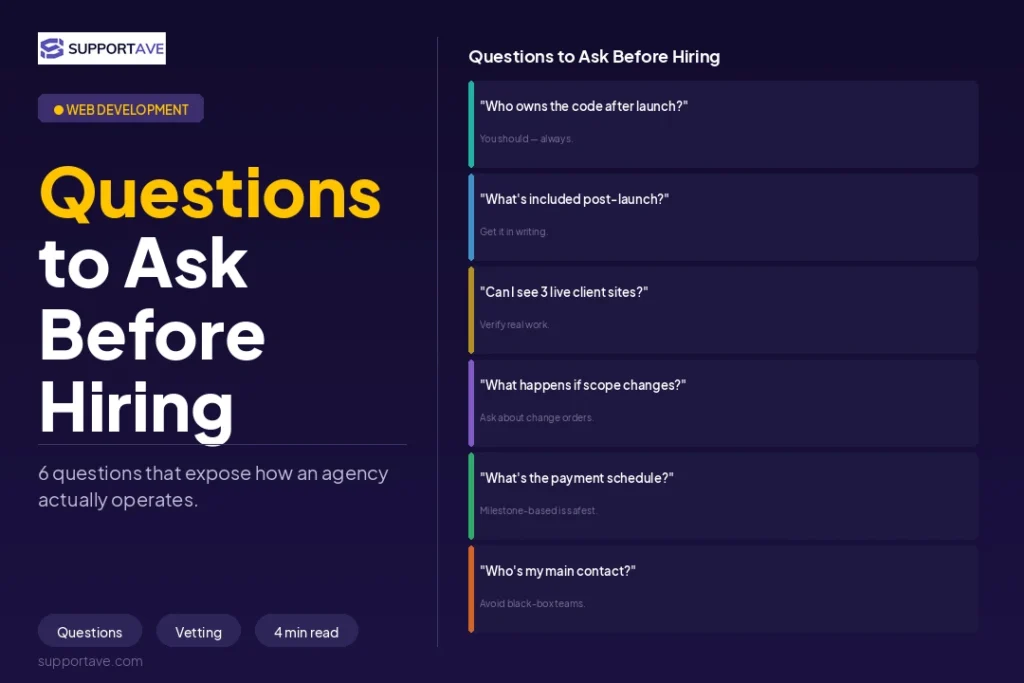
1. What does your discovery process look like, and how is scope locked before build begins?
This is the single most revealing question. A mature agency runs a structured discovery phase: strategy sessions, wireframing, technical architecture, and a signed statement of work before any code is written. This locks scope, prevents cost creep, and protects both parties. An agency that starts designing or coding based on a verbal brief is setting you up for expensive rework.
- Good answer: ‘We have a paid 2–4 week discovery phase. At the end of it, you receive a detailed scope document, timeline milestones, and a fixed-price build quote. No build starts without your sign-off on scope.’
- Red flag: ‘We start with a kickoff call and get to work right away.’
2. Who specifically will work on my project?
The people on the sales call are often not the people who do the work. You need to know the project lead’s name, experience level, and how many concurrent projects they are managing. Junior developers working under minimal supervision — a common structure at larger agencies — is a significant risk for complex builds.
- Good answer: ‘Your project will be led by [Name], a senior developer with 8 years of experience. I can introduce you before we sign. They handle a maximum of two projects at a time.’
- Red flag: ‘Our team will take care of it.’ (No names, no experience level, no capacity information.)
3. Which tech stack do you recommend for my requirements, and why?
Platform selection is a strategic decision, not a default. An agency that recommends the same stack for every project — regardless of your content publishing needs, expected traffic, team’s technical capability, or integration requirements — is not thinking about your business, they’re thinking about their own convenience. If you’re unsure which direction is right for your project, our Next.js vs WordPress comparison covers the practical trade-offs in detail.
- Good answer: ‘Based on what you’ve described — a content-heavy marketing site with no complex backend — we’d recommend WordPress with Kadence or Gutenberg, not Next.js. Next.js would be overkill for your publishing workflow and would add unnecessary development cost.’
- Red flag: ‘We only build in [X]. Everything can be done in [X].’
4. Do I own all code, files, domain, and hosting after the project?
This matters more than it should need to. Some agencies retain rights to themes, components, or frameworks they’ve developed in-house. Others hold your domain, hosting account, or codebase hostage when a relationship ends. As we noted in our guide on custom web development services, the code built specifically for your project should be yours on final payment — full stop. Get this in writing before you sign anything.
- Good answer: ‘You own 100% of all deliverables upon final payment. We’ll transfer the hosting account, repository access, and domain to you at handoff. Any reusable internal libraries we use are disclosed upfront.’
- Red flag: ‘We retain ownership of the theme and design system.’ (Common in agencies using white-labelled products without disclosure.)
5. How do you handle SEO and Core Web Vitals during the build?
A website that looks great but is invisible in search is a visual asset, not a business one. SEO should be built in from day one — not added as an afterthought after launch. Ask specifically about meta title and description setup, sitemap generation, XML schema markup, heading hierarchy, image optimisation, and Core Web Vitals targets.
- Good answer: ‘Our standard build includes Rank Math / Yoast setup, sitemap, canonical tags, proper H1/H2 hierarchy, WebP image optimisation, and a mobile PageSpeed target of 80+. We share a pre-launch SEO checklist for your review.’
- Red flag: ‘SEO is a separate service we can quote for after launch.’
6. What is your QA and testing process?
A professional build is tested — not just by a developer clicking through the site the day before launch. Ask about browser compatibility testing, device testing, form submission testing, load testing, and what automated test coverage exists. According to Project Assistant’s 2026 agency guide, an agency without automated testing will cost you more in bug fixes and delays than any initial saving.
- Good answer: ‘We test across Chrome, Firefox, Safari, and Edge on desktop and mobile. We run Cypress end-to-end tests for critical user flows. We have a 47-point QA checklist we review before any launch sign-off.’
- Red flag: ‘We test it internally before handing it over.’ (No specifics, no process documentation.)
7. What PageSpeed / Core Web Vitals score do your recent projects achieve?
Ask to see PageSpeed Insights scores for three live sites they have built in the past 12 months. Not the portfolio screenshots — the actual live sites. Run them yourself at pagespeed.web.dev. A mobile score above 80 is competent; 90+ is excellent. If an agency built a site that scores 45 on mobile PageSpeed, that is what your site will score too. Performance standards are a habit, not an accident.
8. How do you handle scope changes during the project?
Every project encounters changes. The question is whether those changes are managed with a clear process or absorbed into chaos. An agency with a mature change control process has a template for change orders, documents the time and cost impact before implementing, and requires sign-off. An agency without this will either absorb changes silently (and resent you), or charge surprises at the end.
- Good answer: ‘Any change to scope is documented in a change order. You get a clear description of what changes, the time impact, the cost impact, and your approval before we proceed. No surprises on the final invoice.’
9. What does post-launch support include, and what does it cost after the included period?
Most agencies include 30 days of post-launch bug fixes as standard. After that, you need to understand your options: a monthly maintenance retainer, per-hour billing, or a support plan with defined response times. Orbit Media Studios, with 25+ years of agency experience, identifies post-launch responsiveness as the most common complaint from clients after a project is delivered. Clarify this before you sign.
- Good answer: ’30 days of bug fixes are included. After that, we offer a monthly support retainer at £X/month which includes X hours of development, security updates, and plugin maintenance with a 48-hour response SLA.’
- Red flag: ‘You can always reach out to your project manager.’ (No retainer structure, no response time commitment.)
10. Can you share the pricing breakdown line by line?
A professional agency can tell you exactly what you’re paying for: discovery, design, frontend development, backend development, third-party integrations, QA, deployment, and post-launch. An agency that gives you a lump sum with no itemisation is either protecting a margin they don’t want you to see or doesn’t have a structured project process. According to Zentric Solutions’ 2026 hiring checklist, cheapest quote almost never reflects best value — it usually reflects junior expertise, offshored work without disclosure, or an underestimate that will expand with change requests.
11. What is your AI integration capability?
A web development agency in 2026 that cannot help you implement AI-powered features — personalization, smart form routing, chatbot integration, behavioral analytics — is building you a site that will need significant work again in 12–18 months. Ask specifically: what AI features have they integrated? What LLM providers have they worked with? Do they have experience connecting OpenAI or Anthropic APIs to production web applications?
12. How do you handle data protection and GDPR / CCPA compliance?
For any business with UK, EU, or California users, data protection compliance is not optional. Your agency should have a Data Processing Agreement template ready, understand cookie consent implementation (Consent Mode V2 for Google-integrated sites), and have built sites that comply with accessibility standards (WCAG 2.2 AA is the practical standard for commercial sites in 2026). An agency that dismisses compliance questions is a liability, not a partner.
13. What is your communication cadence during the project?
The most common complaint from clients about web agencies is going silent during the build. Ask specifically: What’s the weekly update format? What project management tool will I have access to? How quickly do you respond to questions? How are blockers escalated? A shared project board on Linear, Jira, or Notion — where you can see progress without chasing status emails — is a sign of operational maturity.
- Good answer: ‘We run weekly progress calls, share a live Notion project board you can view anytime, and respond to messages within 4 business hours. Any blockers on our end are escalated in writing within 24 hours.’
14. Can I speak with two or three recent clients?
Portfolio case studies are curated. Reference calls are candid. Ask for clients from the past 12 months whose project was similar in scope to yours. Ask them: was the project delivered on time? On budget? Would you hire this agency again? What was the hardest point in the project and how did the agency handle it? The answers to these questions will tell you more than any portfolio.
- Red flag: ‘We’d prefer to keep our clients confidential.’ (A confident agency with happy clients will put you in touch with them.)
15. What happens if the project runs over timeline or budget?
This is the question nobody asks — and the one that reveals the most about how an agency handles failure. Every project encounters unexpected complexity. The question is whether the agency communicates proactively when this happens, absorbs reasonable overruns as a professional obligation, or passes every hour of scope creep back to you as a surprise invoice. A professional answer includes a clear escalation process, acknowledgement that they’ve managed overruns before, and honesty about how they communicate when a deadline won’t be met.
The Complete Pre-Contract Checklist
Before signing, verify every item below:
Project Definition
☐ You have written a one-page project brief with measurable success criteria
☐ Your budget is realistic for the scope (check market rates first)
☐ Your target timeline is agreed in writing, not just verbal
Agency Vetting
☐ You have met the project lead and lead developer (not just sales)
☐ You have run PageSpeed tests on 3 live sites they have built
☐ You have spoken with 2-3 recent clients on a reference call
☐ Their portfolio includes projects similar in scope and complexity to yours
Technical
☐ The tech stack recommendation is explained with rationale for your requirements
☐ QA process is documented and includes cross-browser/device testing
☐ SEO setup is included (meta tags, sitemap, schema, Core Web Vitals target)
☐ Accessibility standard is confirmed (WCAG 2.2 AA minimum)
☐ Git repository, version control, and staging environment are confirmed
Commercial
☐ Pricing is itemised by deliverable, not a single lump sum
☐ Code, domain, and hosting ownership are confirmed in writing
☐ Change order process is documented and agreed
☐ Post-launch support is defined with response times and retainer options
☐ Data Processing Agreement is in place if you have EU/UK/CA users
☐ IP ownership clause is in the contract
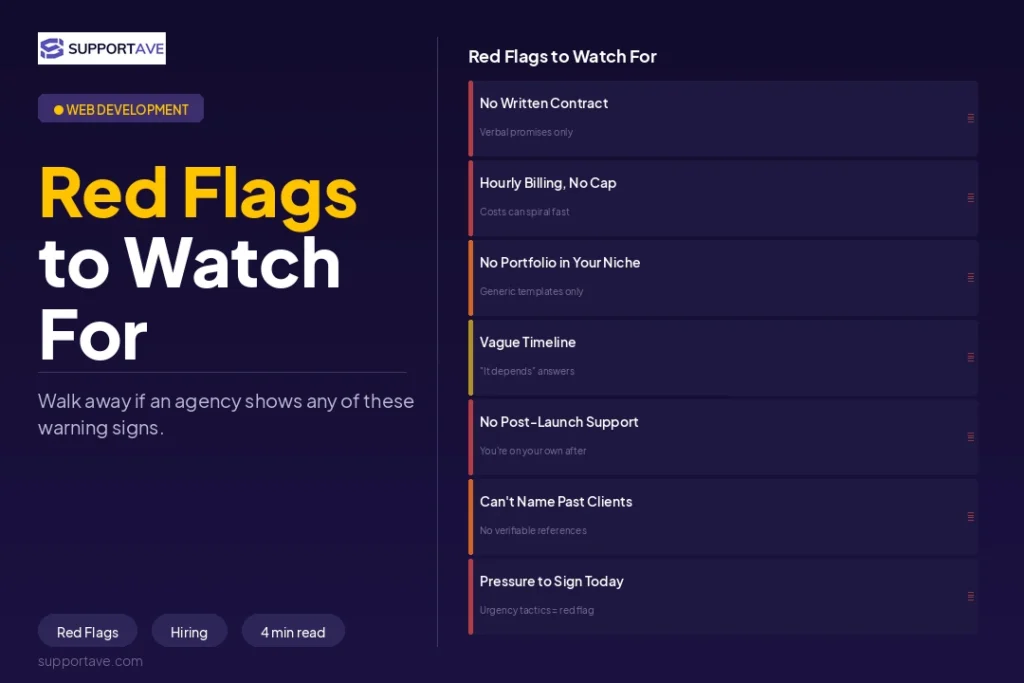
Red Flags — Walk Away If Any Apply
☐ Agency cannot name who specifically will work on your project
☐ No discovery phase — they want to start building based on a brief call
☐ Quote is a single lump sum with no line-item breakdown
☐ Unwilling to provide references from projects in the past 12 months
☐ Post-launch support is vague or undefined
☐ Contract does not specify who owns the code upon final payment
☐ PageSpeed scores on their live portfolio are consistently under 60
Frequently Asked Questions
Should I hire a web development agency or a freelancer?
Agencies offer a team: project manager, designer, developer, QA tester, and post-launch support. Freelancers are typically one person handling everything. Agencies cost more but reduce risk through redundancy and structured process. Freelancers can be excellent for well-defined, smaller-scope projects. For complex builds that require multiple skill sets — full-stack capability, design, DevOps — an agency reduces the coordination overhead of managing multiple contractors. Our guide on full-stack agencies covers when a full-service agency is the right choice versus a specialist hire.
How long should a web development project take?
Timeline depends on scope. A simple business website typically takes 4–8 weeks. A platform with custom backend, user authentication, and third-party integrations runs 12–20 weeks. SaaS or marketplace builds take 4–8 months. If an agency is quoting a timeline that seems unrealistically short, ask them to walk through how they’ll meet it. Rushed timelines are the most common source of post-launch bug overruns. Our website cost guide includes timeline estimates by project type alongside pricing.
What is a reasonable budget to hire a professional web development agency?
Any agency quoting a professional custom website for under $5,000 is either using a recycled template, offshoring without disclosure, or underestimating. A realistic budget for a quality small-business website from a professional agency is $8,000–$20,000. Full-stack web applications and SaaS platforms start at $40,000 and scale significantly from there. These numbers reflect a professional team, structured process, QA, and post-launch support — not just code output.
What does it mean if an agency won’t share references?
It is a significant red flag. A confident agency with satisfied clients will actively encourage you to speak with them. The only reason to withhold references is either that past clients are not satisfied, or that the agency does not maintain strong relationships after handoff — neither of which is encouraging. If a reference call confirms on-time, on-budget delivery with clear communication throughout, that is the most reliable signal you can get.
What are the most common reasons web development projects fail?
Based on consistent patterns across the industry: scope was not locked before build began (scope creep), the wrong developer or agency was selected for the complexity of the project, timeline pressure produced unreviewed code, QA was skipped or compressed, or post-launch there was no defined maintenance plan. All five of these failure modes are addressable before the contract is signed — which is why the discovery phase and the 15 questions in this checklist matter.
Supportave handles web development from discovery through to post-launch support. Every project begins with a fixed-scope discovery phase — no build starts until scope is locked and you’ve reviewed the full statement of work. See our web development services or get in touch to discuss your project.