
Live Chat Support vs AI Chatbots: What Works Best for Small Businesses?
Every small business running a website faces the same question eventually: should customer inquiries be handled by a live human agent or an AI chatbot? The honest answer in 2026 is that asking ‘which is better’ is the wrong question. They solve different problems. This guide gives you the real data on both — cost, conversion, response time, limitations — and a clear framework for deciding what your business actually needs.
Quick Answer: AI chatbots handle volume, availability, and cost, resolving 65-80% of routine inquiries automatically for $0.50-$0.70 per interaction. Live chat handles complexity, trust, and conversion, with agents who can close high-value sales and de-escalate emotional situations. For most small businesses in 2026, the best setup is a hybrid: AI on the front line, humans on escalation.
The Core Difference: What Each One Is Built For
Understanding the practical difference matters before looking at any pricing or benchmark data.
Live chat connects a website visitor with a real human agent in real time. The agent sees the visitor’s history, understands context, reads emotional tone, and can adapt the conversation in ways no current AI system can fully replicate. Live chat is the equivalent of a knowledgeable salesperson standing next to every visitor on your site.
An AI chatbot is software powered by natural language processing and large language models (LLMs). Modern AI chatbots in 2026 use retrieval-augmented generation (RAG) — they search through your actual business content and generate accurate, contextual answers. This is fundamentally different from the rigid rule-based bots of five years ago.
The critical distinction: live chat excels at situations requiring judgement, empathy, and trust. AI chatbots excel at situations requiring speed, availability, and consistency at scale.
| Factor | Live Chat (Human) | AI Chatbot |
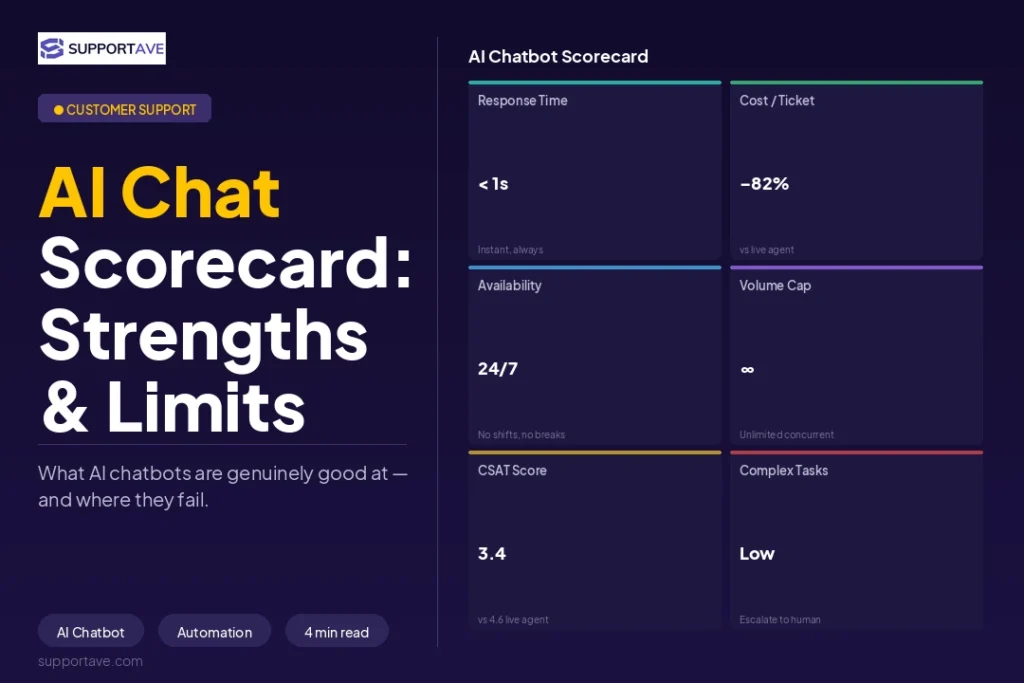
| Response time | 2 min 40 sec average | Under 2 seconds |
| Cost per interaction | $10 – $25 (routine query) | $0.50 – $0.70 |
| Availability | Business hours (or costly shift cover) | 24/7, unlimited concurrent |
| Conversion rate boost | Visitors 2.8x more likely to convert | Lower, but improves with context |
| Handles complex issues | Yes — judgement and empathy | Limited — escalates to human |
| Multilingual support | Limited without specialist hiring | Broad language support |
| Cart abandonment reduction | 25-30% with proactive chat | 15-20% with well-configured bots |
| Setup cost | $20-$59/month software + agent salaries | $29-$150/month most SMB platforms |
The Case for Live Chat Support
Live chat is not just a support channel — when deployed strategically, it is a revenue tool. According to benchmark data, adding live chat to a website boosts conversions by 20% on average. Live chat visitors are 2.8 times more likely to convert and spend 60% more per purchase than those who do not engage. Cart abandonment rates average 70% in 2025 — proactive live chat during checkout reduces abandonment by 25-30%.
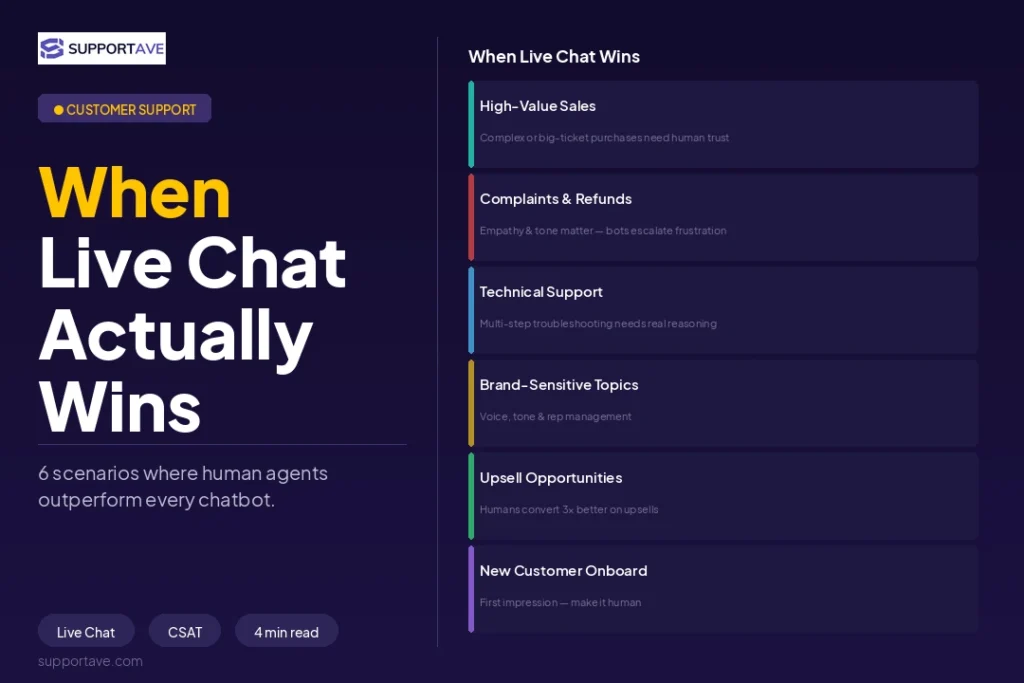
Where live chat genuinely outperforms AI:
- High-value sales conversations: when a prospect is evaluating a $5,000+ purchase or service, they want to speak to a human who can answer unexpected questions and build trust.
- Complaint resolution: an angry customer does not want to hit a bot loop. They want someone who listens, acknowledges their frustration, and offers a real solution.
- Complex, multi-step troubleshooting: issues that require back-and-forth, context from multiple previous interactions, and real-time problem-solving are still better handled by skilled agents.
- Professional and regulated services: healthcare, legal, financial advice — these need human judgment and empathy. Over-automating here damages trust and compliance.
- Premium and luxury brands: connection and trust are part of the value proposition. Automating the first touchpoint can erode the brand positioning you have invested in building.
The Case for AI Chatbots
The economics of AI chatbots are compelling for businesses with volume. According to 2026 data from Layer3 Labs (analysing 2,000+ SMB deployments), AI chatbots can resolve 65-80% of all incoming questions automatically at $0.50-$0.70 per interaction, versus $10-$25 per routine query handled by a human agent.
Klarna’s deployment of an AI support chatbot handled 2.3 million conversations equivalent to 700 full-time agents, cutting average resolution time from 11 minutes to under 2 minutes and generating $40M in annual profit improvement. That is enterprise scale — but the principle holds for small businesses too.
Where AI chatbots genuinely outperform live chat:
- After-hours coverage: a chatbot works 24/7 at no additional cost. Three in-house agents providing 24/7 live coverage costs $7,500-$12,900/month all-in.
- High inquiry volume: during peak periods (product launches, sales events, viral moments), an AI chatbot scales to unlimited simultaneous conversations. A live chat team cannot.
- Routine and repetitive queries: ‘What are your hours?’, ‘Where is my order?’, ‘Do you offer X?’ — these questions have consistent answers and do not require human judgement.
- Multilingual support: modern AI chatbots handle 30-100+ languages without specialist hiring.
- Lead capture outside business hours: a well-configured chatbot can qualify visitors, collect contact information, and hand warm leads to the sales team for morning follow-up.
Stat: According to Gartner research, conversational AI is forecast to reduce contact centre agent labour costs by $80 billion by 2026. The average SMB deploying a chatbot sees $8 returned per $1 invested, with 57% of companies achieving ROI within year one.
The Hybrid Model: Why Most Businesses Should Run Both
The framing of ‘live chat vs AI chatbot’ is a false dichotomy. The most effective customer support operations in 2026 use both — and the performance data supports this clearly.
A hybrid model works like this:
- A customer initiates a conversation through your website widget or messaging channel.
- The AI chatbot responds instantly, pulling answers from your knowledge base.
- If the chatbot resolves the issue (65-80% of the time), the conversation ends with a satisfied customer in seconds.
- If the query is complex, emotional, or the customer requests a human, the chatbot hands off to a live agent — with full conversation context included.
- The human agent picks up where the AI left off, already knowing what the customer needs.
This eliminates the worst of both approaches: the AI handles volume and availability while humans handle complexity and empathy. The handoff is seamless when configured correctly — customers feel they are talking to one unified support team, not navigating between two disconnected systems.
Decision Framework: Which Setup Is Right for Your Business?
| Business Type | Recommended Setup | Primary Reason |
| E-commerce (high volume) | AI chatbot + escalation to human | Volume, after-hours, order tracking |
| SaaS / subscription products | Hybrid (AI + human) | Mix of routine and complex issues |
| Professional services (consulting) | Live chat priority + after-hours AI | Trust and complexity require humans |
| Local businesses | Simple AI chatbot | Hours, location, booking queries |
| Healthcare / legal / finance | Live chat primary | Compliance and sensitivity |
| High-ticket B2B sales | Live chat primary | Sales conversion requires relationship |
| Startups on tight budgets | AI chatbot first | Prove ROI, add human layer as volume grows |
Key Rule: If you are getting fewer than 20-50 chat inquiries daily, you do not need automation — one good support person handles that volume better than any bot and provides a better experience. AI chatbots earn their value at volume. Below volume, the human wins on quality and cost-effectiveness combined.
What to Look For in a Live Chat Support Partner
If you decide live chat is right for your business (or the human layer in a hybrid), outsourcing is typically more cost-effective than in-house hiring for most small businesses. Here is what matters most when evaluating a provider:
- Dedicated agents: agents who work exclusively with your brand, not shared across multiple clients throughout the day.
- Brand voice training: agents trained on your specific tone, product knowledge, and communication style before they handle their first live conversation.
- Direct tool integration: the support team works inside your existing helpdesk (Zendesk, Gorgias, Intercom), not a parallel system.
- QA and performance monitoring: weekly audits, CSAT tracking, and regular feedback loops so quality is maintained, not just promised.
- Transparent pricing: per-agent models are clearer than per-interaction pricing, which can escalate unpredictably during volume spikes.
Frequently Asked Questions
Do AI chatbots replace live chat agents?
Not in 2026, and probably not for several years. AI chatbots handle 65-80% of routine queries effectively, but complex issues, emotionally charged situations, and high-value sales conversations still require human judgement and empathy. The most effective model is AI handling the front line and humans handling escalations. 94% of total live chat costs are staffing-related — so the opportunity is to reduce agent workload on routine tasks, not to eliminate agents entirely.
How much does live chat outsourcing cost?
Outsourced live chat typically costs $15-$35 per agent hour for dedicated agents. Most small businesses with standard business-hours coverage spend $1,500-$4,000/month for a quality outsourced team. 24/7 coverage for a business receiving moderate chat volume typically runs $4,000-$8,000/month depending on inquiry complexity and agent specialisation. This compares favourably with in-house hiring when you factor in salary, benefits, management, and equipment.
Can a chatbot handle sales conversations?
A well-configured AI chatbot can qualify leads, answer product questions, book demos, and collect contact details — all effectively. What it cannot do is build the kind of trust required for a high-consideration purchase. If the sale requires answering unexpected questions, navigating objections, or conveying genuine expertise, a human agent closes at a significantly higher rate. For products under $200-$500, AI-assisted sales work well. Above that threshold, human involvement at some point in the journey almost always improves close rate.
How long does it take to set up a chatbot?
Modern AI chatbot platforms (Tidio, Intercom, FastBots, Gorgias Automate) can be configured and live within hours for basic use cases. A properly trained chatbot — one that accurately reflects your product knowledge, answers your most common questions correctly, and hands off smoothly — typically takes 1-2 weeks to set up properly. Training a chatbot on your knowledge base, testing edge cases, and configuring escalation rules takes time to do right.
What is the best AI chatbot for a small business in 2026?
The best AI chatbot depends on your priority. For simplicity and multi-channel support (website, WhatsApp, Instagram), FastBots.ai is the strongest all-round choice in 2026. For e-commerce brands heavily reliant on Shopify or Gorgias, Gorgias Automate or Tidio integrate more cleanly. For SaaS products needing tight helpdesk integration, Intercom or Freshchat are better fits. All start at under $150/month for most SMB needs.
Supportave provides outsourced website chat support with dedicated human agents trained in your brand voice — available 24/7 and integrated directly into your existing tools. See our live chat services at supportave.com/website-chat-support.