
Mobile App Development with React Native: Cost, Timeline & What to Expect
React Native mobile app development has become the default starting point for most businesses building a cross-platform app in 2026 — and for good reason. A single codebase that ships to both iOS and Android cuts engineering time and cost significantly compared to building two separate native apps. This guide breaks down what React Native actually costs, how long a project realistically takes, what drives the price up or down, and what to expect at each stage. If you’re also weighing your website platform, our React vs Next.js vs WordPress comparison covers the equivalent decision for web — the same React ecosystem powers both.
Quick Answer: React Native app development typically costs between $15,000 and $250,000+ in 2026, with most startup and SMB apps falling between $30,000 and $100,000. A basic MVP takes 6-10 weeks; a medium-complexity app takes 3-5 months; a complex, enterprise-grade app takes 6+ months. The biggest cost lever isn’t your feature list — it’s where your development team is based and how much backend infrastructure your app actually needs.
Why React Native Remains the Default Choice in 2026
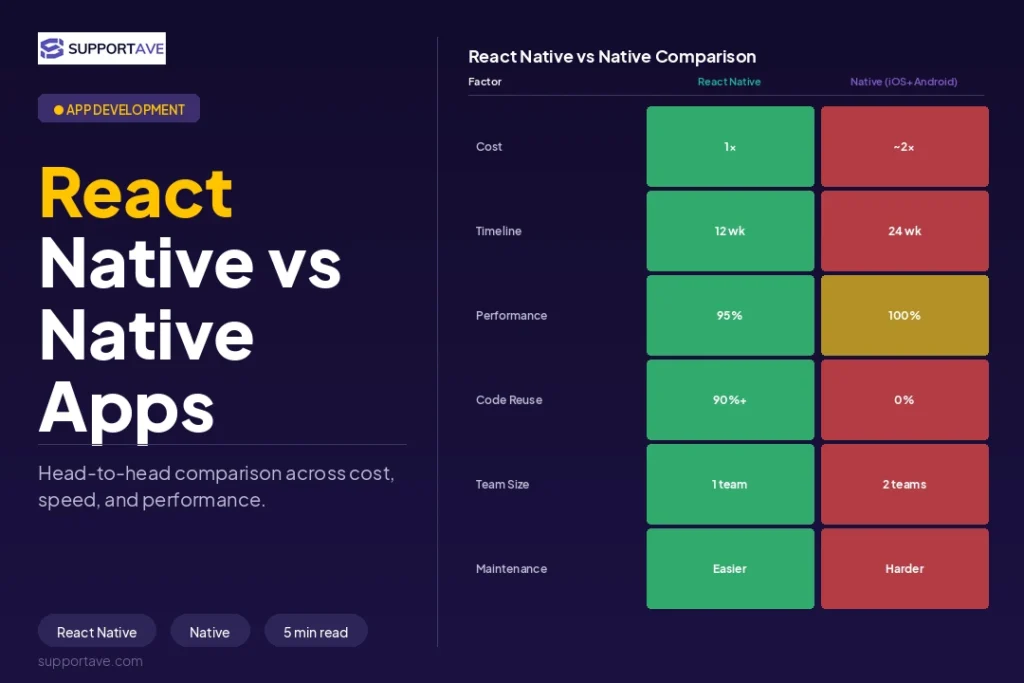
React Native uses a single JavaScript and React codebase to build apps that run natively on both iOS and Android, rather than building two completely separate applications. According to industry estimates, this typically reduces development cost by 30-50% compared to native iOS and Android development as two parallel tracks — because you’re building once, not twice, and every bug fix or feature update ships to both platforms simultaneously.
In 2026, React Native runs on its New Architecture by default — a fundamental rebuild of how JavaScript communicates with native device features, replacing the older ‘bridge’ system that historically caused performance bottlenecks. According to Meta’s own engineering team, this New Architecture brings React Native’s performance meaningfully closer to fully native apps, addressing what used to be the framework’s most cited weakness.
Companies like Instagram and Discord have shipped production apps on React Native at massive scale, which is the practical proof that the framework holds up well beyond MVP-stage products.
What Drives React Native Development Cost
1. App Complexity — The Primary Driver
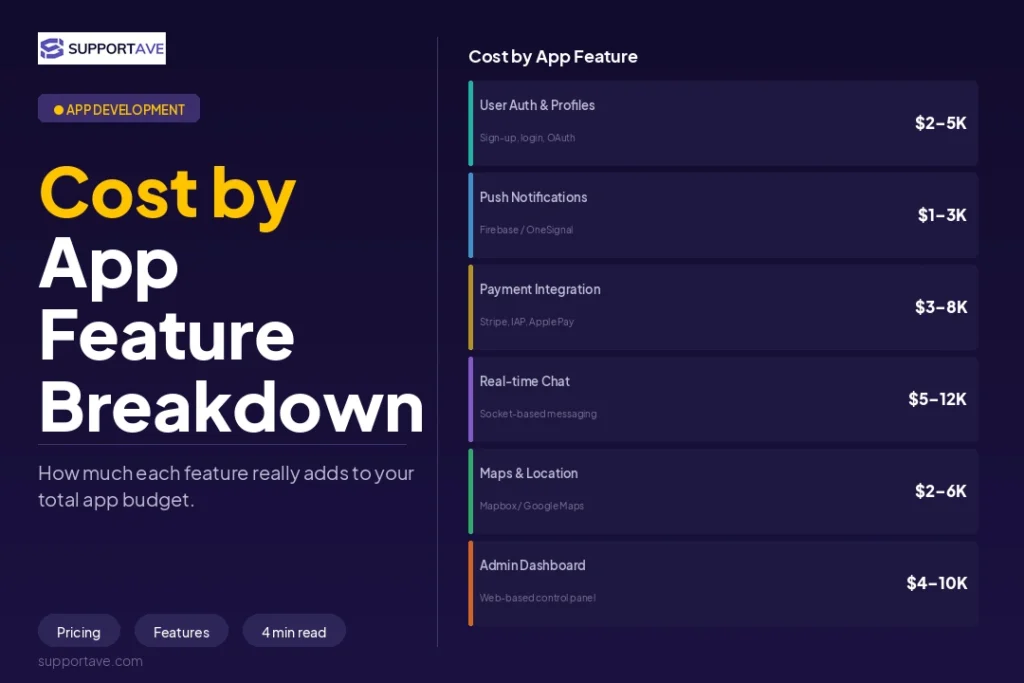
This is, unsurprisingly, the single biggest factor. Basic apps with static content, simple login, and minimal features typically cost $15,000-$35,000. Medium-complexity apps with user authentication, payment integration, API connectivity, and interactive elements generally run $35,000-$80,000. Complex apps involving real-time data, AI features, extensive backend integration, or multimedia streaming usually range from $120,000-$250,000, and can exceed $300,000 for genuine enterprise requirements.
2. Backend Infrastructure
Most apps need a server, a database, and a set of APIs to function — and backend work often accounts for 30-40% of total project cost, according to Space to Tech’s 2026 cost analysis. This is the part of the budget most first-time founders underestimate, because the frontend (what you see in the app) is visually obvious while the backend (what makes it actually function) is invisible until it’s missing.
3. Third-Party Integrations
Connecting to Google Maps, Stripe, Twilio, Firebase, or social login providers adds development time on top of the base build. Each integration typically adds $500-$3,000 to your budget depending on complexity — and most real-world apps need several of these, not just one.
4. Security and Compliance
Apps handling payments or healthcare data need encryption, secure API design, and compliance work — GDPR for EU users, HIPAA for US healthcare data. Security-focused development adds 15-25% to total cost, but this is genuinely non-negotiable for any app handling sensitive user data; cutting corners here creates liability that costs far more than the upfront investment.
5. Real-Time Features
Chat functionality, live GPS tracking, or real-time dashboards require WebSockets or push notification services like Firebase Cloud Messaging. These add both technical complexity to the build and meaningfully more testing effort, since real-time systems fail in ways that are harder to reproduce and debug than standard request-response features.
6. AI Integration
In 2026, AI features — chatbots, recommendation engines, image recognition — are increasingly standard rather than exceptional. Expect to budget $5,000-$25,000+ extra for AI integration, depending on depth and whether you’re connecting to an existing LLM API or building custom model infrastructure.
Cost by Region: Where Your Team Sits Matters Most
| Region | Typical Hourly Rate | Best For |
| United States / Canada | $60-$150+/hour | Tight in-person collaboration, complex regulatory requirements |
| Western Europe | $50-$120/hour | EU compliance needs, timezone-aligned teams |
| India / South Asia | $15-$50/hour | Cost-efficient builds with rigorous QA, 60-70% savings vs US/UK |
| Eastern Europe | $30-$70/hour | Strong technical talent at moderate cost |
This is the single biggest cost lever in the entire budget — more than features, more than complexity. India-based agencies typically deliver comparable (often equally rigorous) technical output at 60-70% lower cost than US or Western European firms. The trade-off isn’t necessarily quality; it’s communication overhead, timezone management, and how hands-on you want the collaboration to be.
Realistic Cost Ranges by App Type
| App Type | Cost Range | Timeline |
| MVP (core features only) | $15,000-$30,000 | 6-10 weeks |
| Medium-complexity app (auth, payments, API) | $35,000-$80,000 | 3-5 months |
| Complex app (real-time, AI, heavy backend) | $120,000-$250,000 | 6+ months |
| Enterprise-grade platform | $200,000-$300,000+ | 8-12+ months |
What an MVP Build Actually Looks Like
Most smart founders start with a Minimum Viable Product — building the core of the product, getting it in front of real users, and validating demand before spending significantly more. A well-scoped React Native MVP focuses on:
- User authentication (email/social login) — not every login method, just the one your users actually need first
- 5-8 core screens — the minimum needed to deliver your app’s central value, not every feature on your eventual roadmap
- Basic push notifications — enough to re-engage users, not a full marketing automation system
- One payment method — proven first, expanded later once you have real transaction data
The features deliberately left out at MVP stage — an admin panel, AI features, deep analytics — get added in version 2, once real user feedback tells you which of them are actually worth building. A well-scoped MVP takes 6-10 weeks. The minimum team for this stage: one React Native developer, one UI/UX designer, one backend developer, one QA tester, and a project manager.
Common mistake: Rushing the MVP phase to save money creates technical debt that costs significantly more to fix later. A mid-complexity React Native application typically requires 150-300 hours of QA effort to reach release-ready stability — businesses that compress this timeline to cut costs usually absorb those costs later as negative reviews and emergency hotfix deployments.
Post-Launch: The Cost Nobody Budgets For
A React Native build is not ‘pay once and forget.’ Apple and Google update their operating systems constantly, and your app needs to keep pace. Ongoing costs after launch typically run 10-20% of the initial development cost annually, covering:
- OS compatibility updates — new iOS and Android versions can break existing functionality without warning
- Library and dependency updates — React Native and its third-party packages require regular updates for security and compatibility
- Server and infrastructure costs — AWS, DigitalOcean, or Firebase usage scales with your user base
- Bug fixes and minor feature work based on real user feedback
Budgeting for this from the start — rather than treating it as a surprise six months post-launch — is the difference between a sustainable product and one that quietly degrades until users start abandoning it.
Questions to Ask Before Hiring a React Native Team
The same diligence that applies to hiring any web development agency applies here, with a few React Native-specific additions:
- Have you shipped React Native apps similar in complexity to mine? Ask to see them live on the App Store and Google Play, not just screenshots.
- How do you handle the backend — in-house team, or do you only build the frontend and expect me to source backend separately?
- What does your QA process look like, and how many hours of testing do you budget for a project of my scope?
- What happens after launch — is post-launch support included, and for how long?
- Can you walk me through how you’d handle [specific integration I need] — payment gateway, real-time chat, or whatever your app’s core feature requires?
Frequently Asked Questions
Is React Native cheaper than building separate native iOS and Android apps?
Generally yes. Because React Native shares a single codebase across both platforms, it typically reduces development cost by 30-50% compared to building and maintaining two fully separate native applications. The savings continue after launch too, since most updates and fixes only need to be made once rather than twice. The exception is apps that depend heavily on platform-specific capabilities — advanced camera features, Bluetooth Low Energy, background processing — where native development may reduce technical risk even at higher cost.
Can I build a professional React Native app for under $20,000?
It’s very difficult to get a genuinely professional, launch-ready app at that price point in 2026. You can find someone to build something for $5,000-$10,000, but fixing a poorly built app typically costs more than building it correctly the first time would have. A realistic floor for a professional MVP with proper QA, security, and a functioning backend is closer to $15,000-$30,000.
How long does a React Native app actually take from idea to App Store?
A simple MVP typically takes 6-10 weeks of development, plus 1-2 weeks for app store submission and review (Apple’s review process can take several days to two weeks; Google Play is usually faster). Medium-complexity apps run 3-5 months total. Complex, feature-rich apps take 6 months or more. These timelines assume a properly scoped project with locked requirements — scope changes mid-build are the most common cause of timeline overruns.
Do React Native apps perform as well as fully native apps?
With the New Architecture, which became React Native’s default starting in version 0.76, performance is meaningfully closer to native than older versions of the framework. For the vast majority of business apps — content, e-commerce, booking, social, productivity — users won’t notice a difference. The remaining gap matters most for graphically intensive apps (high-end games) or apps requiring very specific low-level hardware access, where fully native development still holds an edge.
What’s included in ‘backend development’ and why does it cost so much?
Backend development covers the server infrastructure, database design, API endpoints, user authentication logic, and business rules that make your app actually function — everything that happens behind the screen the user sees. It typically represents 30-40% of total project cost because it’s where most of an app’s genuine complexity lives: data security, scalability, third-party integrations, and the logic that determines what happens when a user takes any action in the app.
Supportave builds React Native mobile apps from MVP through to enterprise scale, with full-stack capability covering frontend, backend, and post-launch support. See our web development services or contact us to scope your app project.