
10 Signs Your Website Needs a Full Redesign (Not Just a Refresh)
Most business owners sense it before they admit it: the website is not working the way it should. Visitors come and leave. The contact form sits silent. The site looks like it was built for a different era — because it was. This article gives you 10 concrete, diagnosable signs that your website needs a full redesign, not a new logo or a quick content update.
Quick Answer: Your website needs a full redesign when structural problems — slow speed, broken mobile layout, poor conversion architecture, or outdated platform — cannot be fixed by surface updates alone. If three or more of the signs in this article apply to your site, a redesign will almost always deliver better ROI than continued patching.
Sign 1: It Takes More Than 3 Seconds to Load
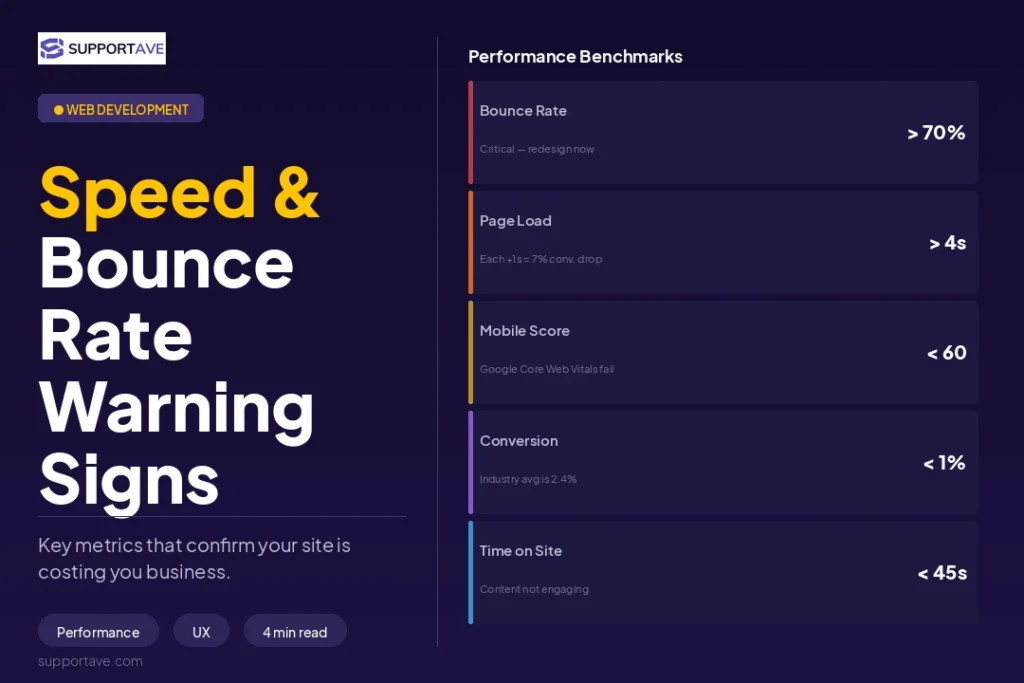
Page speed is one of Google’s confirmed ranking factors, and users are ruthless about it. Studies consistently show that more than half of visitors abandon a site that takes longer than 3 seconds to load — and they rarely come back. In 2026, Google uses Core Web Vitals (Largest Contentful Paint, Cumulative Layout Shift, Interaction to Next Paint) as direct ranking signals.
Common causes of a slow site: uncompressed images, bloated plugins, cheap shared hosting, outdated code, and a poorly structured database. These are often symptoms of an aging site architecture that patching cannot fix efficiently.
How to check: run your URL through Google PageSpeed Insights (free). A score under 70 on mobile is a red flag. Under 50 is a serious problem.
Stat: Research shows that a 1-second delay in page load time results in a 7% reduction in conversions. For a site generating $10,000/month in leads, that is $700 in lost revenue every month from a single second of lag.
Sign 2: It Breaks on Mobile
In July 2025, 58.39% of global web traffic came from mobile devices. Google uses mobile-first indexing, meaning it ranks your site based on the mobile version — not the desktop version you probably designed for. A site that looks polished on a laptop but has overlapping text, tiny tap targets, and broken layouts on a phone will rank lower and convert worse across every channel.
Symptoms of a mobile problem:
- Text is too small to read without zooming
- Buttons and links are too close together to tap accurately
- Forms overflow the screen or fields are impossible to fill
- Images are cropped or stretched incorrectly
- Navigation menus collapse into unusable formats
This is rarely fixable with a CSS tweak. Mobile-first design has to be built into the architecture from the start — retrofitting it onto a desktop-first site is like widening a road from the inside.
Sign 3: You Are Not Getting Leads or Enquiries
Traffic without conversions is wasted marketing spend. If your site gets visitors but the contact form stays empty, the phone does not ring, and the inquiry queue is silent — the problem is almost always the website, not the traffic source.
The most common conversion killers:
- No clear call to action above the fold — visitors do not know what to do next
- Contact information buried in the footer or on a hard-to-find page
- Too many navigation options competing for attention
- No social proof — no reviews, testimonials, case studies, or client logos
- A value proposition that describes the business instead of solving the visitor’s problem
This is a structural UX and copywriting issue. Older sites were often built for appearance rather than conversion — modern web design leads with the visitor’s next step, not the company’s history.
Sign 4: The Design Feels Visually Dated
Visitors form a visual impression of your brand in under 0.05 seconds according to research published in Behaviour & Information Technology — before a single word is read. An outdated aesthetic signals to potential customers that your business may be behind the times, less active, or less credible than competitors.
Design trends move fast. What looked modern in 2021 already feels dated in 2026. Specific visual signals that age a site:
- Heavy drop shadows, gradients, and bevelled buttons from the skeuomorphic era
- ‘Boxy’ grid layouts with rigid equal-width columns
- Stock photography that looks obviously generic
- Cluttered homepages with too many competing visual elements
- Font combinations that predate variable fonts and modern web typography
Open your site next to your top three competitors. If theirs look more trustworthy, more modern, or simply more intentional — your visitors are making the same comparison and drawing the same conclusion.
Sign 5: Your Organic Traffic Has Dropped
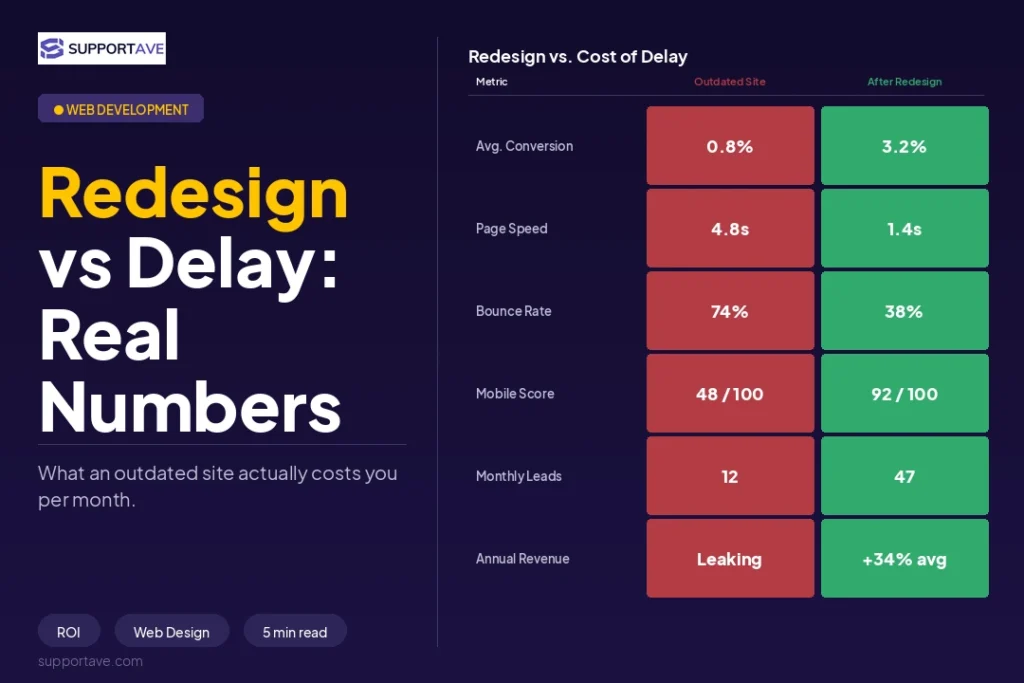
SEO in 2026 requires more than keywords on the page. It requires fast load times, mobile-first design, proper schema markup, clean URL structure, strong Core Web Vitals scores, and content structured for AI answer engines. Older websites often have bloated code, poor heading hierarchies, outdated plugin conflicts, and content that was never optimised to begin with.
A redesign gives you the opportunity to rebuild SEO foundations from scratch — properly. This includes:
- Clean URL architecture with logical hierarchy
- Proper heading structure (H1 → H2 → H3) on every page
- Meta tags, schema markup, and structured data implemented correctly from launch
- Image optimisation and lazy loading baked into the build
- Internal linking structure that distributes authority across important pages
Important: Updating and improving old content can produce dramatic results. Search Engine Journal reported a 60% increase in organic traffic after refreshing and pruning outdated, low-performing articles. A redesign is the right moment to audit, consolidate, and improve your entire content catalogue.
Sign 6: Your Business Has Outgrown the Site
Businesses evolve. Services change. New products launch. The team grows. Positioning sharpens. But many websites are frozen in time — still featuring old service descriptions, outdated pricing, team photos from three years ago, and a value proposition that no longer reflects what the business actually does.
A prospect who arrives from a referral, a LinkedIn profile, or a Google review expects the site to match their expectation. When it does not — when the messaging is misaligned, the services list is incomplete, or the ‘about’ section describes a different version of the company — trust erodes before they even make contact.
Sign 7: You Cannot Update It Without Calling a Developer
If making simple changes — updating a team bio, adding a blog post, changing a price — requires you to file a support ticket and wait for a developer, your site is built on an outdated platform or a tightly locked architecture that is costing you money and agility.
Modern CMS platforms (WordPress with Gutenberg, Webflow, or a headless CMS with a no-code editor) let non-technical team members update content confidently. If your current site cannot do this, it is slowing down your marketing operation every month.
Sign 8: The Site Is Not Secure
Security issues are not just technical problems — they directly affect search rankings and user trust. Google displays ‘Not Secure’ warnings for sites without valid SSL certificates, and Chrome will block users from accessing flagged sites. In 2026, site security means:
- A valid SSL certificate (HTTPS, not HTTP)
- Regularly updated CMS, plugins, and dependencies
- No malware, injected scripts, or blacklisted domains
- Proper user data handling and GDPR/CCPA compliance
Outdated sites are disproportionately vulnerable. WordPress sites running old plugin versions are the most common vector for malware injection. If your site has been flagged by Google Search Console, has unresolved security warnings, or was built on a platform that no longer receives security updates — a rebuild is not optional.
Sign 9: Your Competitors Look Significantly Better
This is the most uncomfortable sign, but one of the most actionable. Open your top three competitors’ websites side by side with yours. Ask the question directly: if a prospect were comparing these four sites with no prior knowledge of any of the companies — which one would they trust most?
First impressions are overwhelmingly visual and happen in seconds. A visitor who lands on a site and gets a ‘this feels dated’ impression will often bounce before reading a single sentence. They will find the competitor with the more credible site. You will never know it happened — but it is happening constantly if the gap exists.
You do not need the flashiest site in your industry. You need a site that communicates competence, professionalism, and trustworthiness at least as well as the alternatives your prospects are considering.
Sign 10: Your Analytics Are Missing or Broken
A website you cannot measure is a website you cannot improve. If your analytics are not set up, are showing unreliable data, or were implemented years ago without being updated for GA4 and modern event tracking — you are making design, content, and budget decisions based on guesswork.
A redesign is the right moment to implement analytics correctly from day one: GA4 event tracking, Google Search Console verification, heatmaps and session recording, conversion tracking tied to real business goals, and a dashboard that tells you which pages convert and which ones leak.
Redesign vs Refresh: How to Decide
Not every problem requires a full rebuild. Use this framework:
| Issue | Refresh Sufficient? | Full Redesign Needed? |
| Outdated photos / content | Yes | No |
| One slow page | Yes | No |
| Small navigation fix | Yes | No |
| Mobile broken site-wide | No | Yes |
| Low scores across Core Web Vitals | No | Yes |
| Conversion rate below 1% site-wide | No | Yes |
| Platform is outdated / unsupported | No | Yes |
| 3+ signs from this article apply | No | Yes |
Rule of Thumb: If your site scores poorly on mobile, loads slowly across the board, does not convert visitors into leads, or no longer reflects your business accurately — those are structural problems that updates will not fix. A full redesign built on a modern platform is usually the more cost-effective long-term solution.
Frequently Asked Questions
How often should a website be redesigned?
Most professional websites benefit from a full redesign every 3-4 years. Technology, design standards, and search algorithm requirements evolve fast enough that a site built in 2021 is already carrying structural disadvantages in 2026. However, the trigger should be performance data, not a calendar — if your site is converting well, ranking well, and loading fast, there is no reason to rebuild it on schedule.
Will a redesign hurt my SEO rankings?
A poorly planned redesign can damage rankings. A well-planned one typically improves them. The key is to implement proper 301 redirects for any changed URLs, preserve content that is currently ranking, and launch on a faster, more structured platform. Many businesses see rankings improve within 60-90 days of a properly executed redesign because they have fixed speed, structure, and mobile issues that were suppressing visibility.
How long does a website redesign take?
A well-scoped redesign for a small to mid-size business typically takes 6-12 weeks from strategy through launch. Simple 5-10 page sites can be completed in 4-6 weeks. Complex sites with e-commerce, custom integrations, or large content libraries take 12-20 weeks. Rushing the process tends to produce sites that need to be rebuilt sooner.
What is the difference between a website redesign and a website refresh?
A refresh updates the surface layer: new photos, updated copy, a revised colour scheme, or a few new pages. The underlying structure, platform, and architecture stay the same. A redesign rebuilds the site from the ground up — new platform (or properly rebuilt existing platform), new design system, new navigation architecture, new conversion strategy, and technical foundations rebuilt to current standards.
How much does a website redesign cost?
For a small to mid-size business, professional redesigns typically range from $5,000 to $20,000 depending on size and complexity. According to OneLittleWeb’s 2026 pricing study, most professional builds fall between $3,000 and $15,000. The cost of not redesigning — in lost leads, lower rankings, and weakened brand credibility — often exceeds the investment within a year.
Supportave builds custom websites for businesses ready to go from digital liability to competitive asset. See our web development services at supportave.com/web-development.