
Virtual Assistant vs In-House Employee: The Real Cost Comparison
The conversation about virtual assistants versus in-house employees almost always starts with hourly rate comparisons and stops there. The actual comparison is more revealing, and significantly more in favour of virtual assistants for a wider range of roles than most business owners realise. This guide breaks down the real, fully loaded cost of both models in 2026, the tasks each is genuinely best suited for, and a decision framework that goes beyond the headline numbers. If you are specifically considering outsourcing customer support tasks, our complete customer support outsourcing guide covers the support-specific models, costs, and partner evaluation in detail.
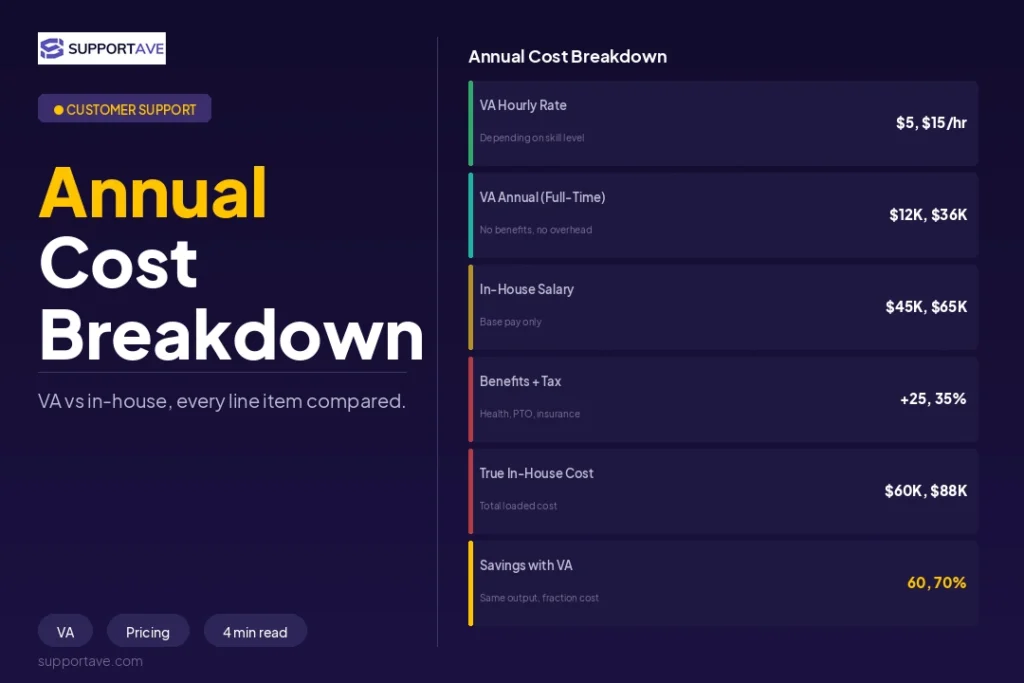
Quick Answer: A fully loaded in-house employee in the US or UK typically costs $65,000 to $90,000+ per year when salary, payroll taxes, benefits, equipment, office space, and recruitment are included, according to Virtual Business Staffing’s 2026 analysis. A skilled virtual assistant costs $10,000 to $30,000 per year through a managed agency, with zero benefits overhead, no office costs, and no employer obligations. For the right tasks, this gap represents 40 to 70% cost savings.
The Real Cost of an In-House Employee in 2026
Most business owners compare a VA’s hourly rate to an employee’s salary and think they have done the math. They have not. The US Small Business Administration consistently reports that the true cost of a full-time employee is 1.25x to 1.4x their base salary once all employer obligations are factored in.
Here is what a mid-level administrative or support hire actually costs in the US:
| Cost Component | Annual Cost (US Mid-Level Admin) |
| Base salary | $42,000 to $55,000 |
| Payroll taxes (FICA, FUTA, SUTA) | $4,000 to $6,000 |
| Health insurance contribution | $7,000 to $12,000 |
| Paid time off (15 days average) | $2,400 to $3,200 |
| Retirement plan contribution | $1,200 to $2,200 |
| Equipment (laptop, phone, peripherals) | $1,500 to $2,500 (first year) |
| Office space (allocated share) | $3,000 to $8,000 |
| Recruitment cost (SHRM average: $4,700) | $4,700 (one-time, first year) |
| Training and onboarding | $1,000 to $2,500 (first year) |
| TOTAL | $66,800 to $101,000+ per year |
And there is one more cost that does not appear in any spreadsheet: when an in-house employee is sick, on holiday, or dealing with a personal emergency, productivity stalls. Payroll does not. A virtual assistant, by contrast, is typically available through a managed service that provides a replacement if availability changes.
The Real Cost of a Virtual Assistant in 2026
VA costs vary significantly by location, skill level, and engagement model. Here is how the market breaks down in 2026:
| VA Model | Hourly Rate | Full-Time Equivalent (Annual) | Best For |
| Philippines, general admin | $3 to $7/hr | $6,000 to $14,000 | Administrative, scheduling, data entry |
| Philippines, specialist (support, marketing) | $8 to $20/hr | $16,000 to $40,000 | Customer service, social media, bookkeeping |
| Latin America | $15 to $35/hr | $30,000 to $70,000 | US timezone alignment, bilingual roles |
| US-based, managed agency | $25 to $60/hr | $51,000 to $122,000 | Client-facing, native English, compliance-heavy |
| Part-time VA (20hrs/week) | $10 to $35/hr | $10,000 to $36,000 | Business owners not needing full-time coverage |
According to VA Masters’ 2026 cost analysis, a Filipino virtual assistant through a managed agency costs 70 to 80% less than a comparable US in-house employee when all employer costs are factored in. Companies using virtual assistants consistently report 40 to 60% lower operational costs according to CapStonePlanet’s 2026 VA placement data across 200+ engagements.
The Virtual Assistant vs In-House Employee Decision: Task Fit Framework
Cost is not the only variable. The right model depends on what the role actually requires. Some work is genuinely better served by an in-house employee. Most operational and administrative work is not.
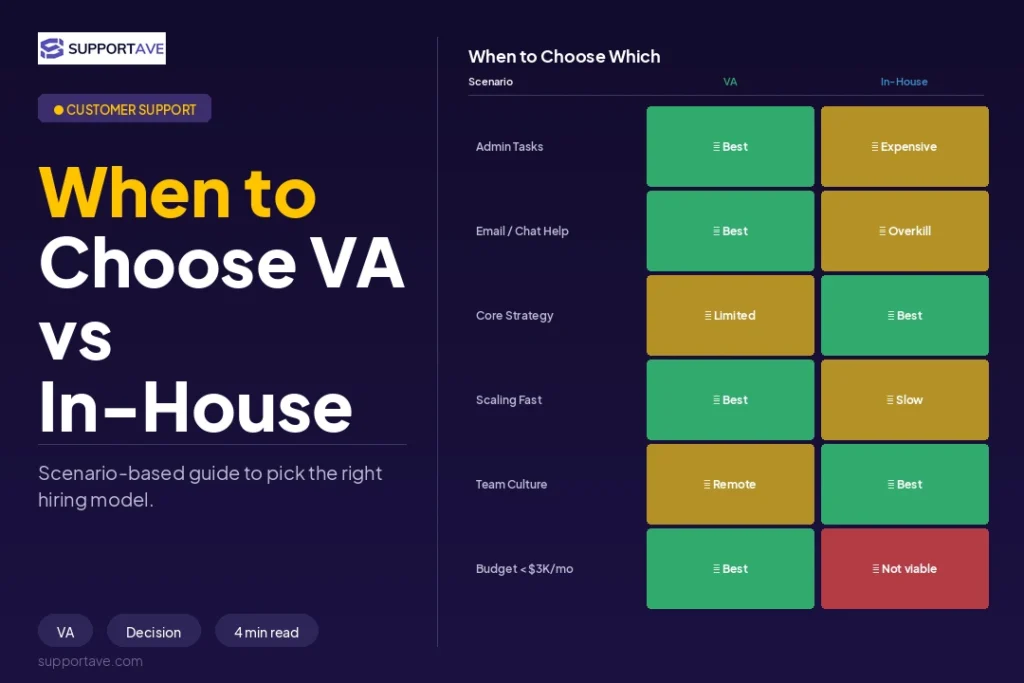
Tasks where a virtual assistant is the better choice
- Administrative and operational work: scheduling, calendar management, inbox management, data entry, research, and reporting are all process-driven tasks that a well-briefed VA can handle reliably without being physically present.
- Customer support: email, chat, and social media support can be handled remotely at high quality, particularly when integrated directly into your helpdesk platform. For e-commerce and SaaS businesses, outsourced support teams often outperform in-house hires at a fraction of the cost.
- Content and marketing support: social media scheduling, blog formatting, basic graphic tasks, and email campaign management are well-suited to a skilled remote VA.
- Variable workload: when your workload is seasonal or inconsistent, a VA arrangement lets you scale hours up or down without navigating HR processes, giving notice periods, or worrying about severance costs.
Tasks where an in-house employee is the better choice
- Real-time decision-making and crisis response: roles requiring urgent, in-person judgment calls, crisis response, or live client negotiations need someone physically present and immediately accountable.
- Culture and management: team leads, managers, and anyone responsible for mentoring or developing other staff need to be embedded in the workplace. VAs can be long-term partners, but they cannot attend an in-person standup or mentor junior staff in real time.
- Highly sensitive regulatory roles: in healthcare, financial services, and legal settings, some functions require local licensing, compliance oversight, or physical presence that remote arrangements cannot reliably provide.
- Leadership and strategy: revenue accountability, direction-setting, and institutional knowledge require full embedded involvement. These roles are almost always better served by an in-house hire.
The Hybrid Model: What Most Growing Businesses Actually Use
The companies scaling most efficiently in 2026 are not choosing between employees and VAs. They are using both strategically, with in-house staff anchoring core functions and virtual assistants handling delegatable operational work.
A common structure for a business with 5 to 15 employees:
- In-house: CEO/founder, 2 to 3 client-facing or product-facing roles, 1 operations manager.
- Virtual: administrative assistant handling scheduling and inbox, customer support handled by a managed outsourced team, bookkeeper (part-time VA), social media manager (part-time VA), data analyst (project-based VA).
According to VA Masters, a fintech client of theirs has a CTO in-house focusing on strategy, while a Filipino QA assistant handles quality testing, project management, and documentation remotely. The operations manager coordinates the virtual layer, creating a seamless operation where the in-house team concentrates entirely on work that requires their direct expertise and presence.
The real question: Not ‘VA or employee?’ but ‘Which roles in my business actually need to be in-house?’ Business owners and executives who honestly answer that question consistently find that 50 to 80% of their operational support work does not need to be physically present to be done well.
What Supportave’s Virtual Assistant Service Covers
Our virtual assistant service provides dedicated remote professionals for business owners and growing teams. Common tasks our VAs handle include: inbox and calendar management, customer support (email, chat, and social media), scheduling and appointment coordination, CRM data management, research and reporting, and content scheduling. See our virtual assistant services for a full breakdown of available tasks and how our managed matching process works.
Frequently Asked Questions
How do I know which tasks are suitable for a virtual assistant?
A practical test: if you can write the task as a checklist or a documented process, a trained VA can almost certainly handle it. If the task requires you to be physically present, involves real-time in-person judgment, or requires institutional access that only an employee can have, it belongs in-house. Business owners who log their own task list for one week typically find that 50 to 80% of what they are doing personally would be better delegated to a VA.
Is a managed VA agency worth the premium over hiring a freelancer directly?
For most businesses, yes. A managed agency handles recruiting, vetting, onboarding, and replacement, removing the management overhead that direct hiring creates. If a VA does not work out, the agency provides a replacement within days rather than weeks. The premium is typically 20 to 40% above a direct freelancer rate but covers significant risk reduction. The breakeven point is usually reached when you factor in the time cost of sourcing and vetting a direct hire yourself.
Can a virtual assistant work in my timezone?
Yes. Most managed VA services offer timezone-aligned availability as a standard feature. Filipino VAs commonly work graveyard shifts to align with US and UK business hours, and this is standard practice in the industry. Latin American VAs overlap naturally with US timezones without any shift adjustment required. Specify your required hours upfront when engaging a VA service and confirm timezone alignment before placement.
How quickly can a virtual assistant be productive?
A well-briefed VA through a managed agency typically reaches productive operational capability in 2 to 3 weeks, compared to 3 to 6 months for a newly hired in-house employee navigating a company for the first time. The speed depends on the quality of your onboarding documentation and SOPs. VAs who receive a written task guide, access to relevant tools, and clear expectations in the first week consistently ramp faster than those who are given verbal instructions and expected to figure out the process independently.
What is the difference between a virtual assistant and a BPO service?
A virtual assistant is typically one individual (or a small team) handling a range of tasks assigned directly by you. A BPO (Business Process Outsourcing) provider is an organisation that takes over a complete business function, for example customer support, with their own management layer, QA programme, and staffing infrastructure. VAs are better suited for business owners who want direct control over a versatile remote team member. BPO services are better suited when you need to offload an entire operational process at volume, with defined SLAs and a managed team structure.
Supportave provides dedicated virtual assistants matched to your business requirements and available in your timezone. See our virtual assistant services or contact us to discuss your requirements.