
24/7 Customer Support: Why It Matters and How to Offer It Affordably
Most businesses know they should offer 24/7 customer support. Far fewer know how to do it without building a team that costs more than it generates in retained revenue. This guide covers why round-the-clock availability has moved from a differentiator to a baseline expectation, what each delivery model actually costs, and how businesses of every size can build always-on support without unsustainable overhead. If you are newer to the topic of outsourcing support in general, our complete customer support outsourcing guide covers the full landscape of models, costs, and provider selection before you get into the specifics of 24/7 coverage.
Quick Answer: 24/7 customer support means your customers can reach you at any hour through at least one channel, not necessarily all channels simultaneously. The three most cost-effective models for most businesses are: outsourced human agents covering off-hours using a dedicated BPO provider, an AI chatbot handling routine queries overnight with human escalation in the morning, and a hybrid where your in-house team handles business hours and an outsourced team covers the rest. In-house 24/7 coverage for a small team costs $7,500 to $12,900 per month in staffing alone. The same coverage through a quality outsourcing partner typically costs $3,500 to $6,000 per month.
Why 24/7 Support Has Become a Business Requirement, Not a Premium Feature
Customer patience has measurably declined. According to HubSpot’s 2026 customer experience data, customers who receive a fast response to their support inquiry are more likely to return and spend more over their lifetime with a business. Customers who do not receive a response until the next business day are significantly more likely to have already found an alternative by the time you reply.
The business case is most visible in three specific scenarios:
- E-commerce checkout abandonment: a customer encountering an error at 11pm during checkout has exactly two outcomes available. They either get help immediately and complete the purchase, or they close the tab and buy from a competitor whose chat is staffed. Cart abandonment averages around 70% across e-commerce. Removing late-night friction from that number is a direct revenue impact.
- SaaS trial-to-paid conversion: users evaluating software during their trial period do not confine their testing to 9am to 5pm. A question that goes unanswered for 12 hours during a trial can end an evaluation. Support responsiveness during trials is a measurable driver of conversion rate.
- International expansion: once your customer base crosses time zones, business-hours support creates a built-in service gap for customers in other regions. 24/7 coverage is not optional for any business genuinely operating internationally.
The Fortune Business Insights projection is relevant context here: the global BPO market is expected to grow from $353.64 billion in 2026 to $741.60 billion by 2034. The primary driver is not cost arbitrage. It is the expectation of always-on availability that businesses cannot economically meet with in-house teams alone.
The True Cost of In-House 24/7 Support
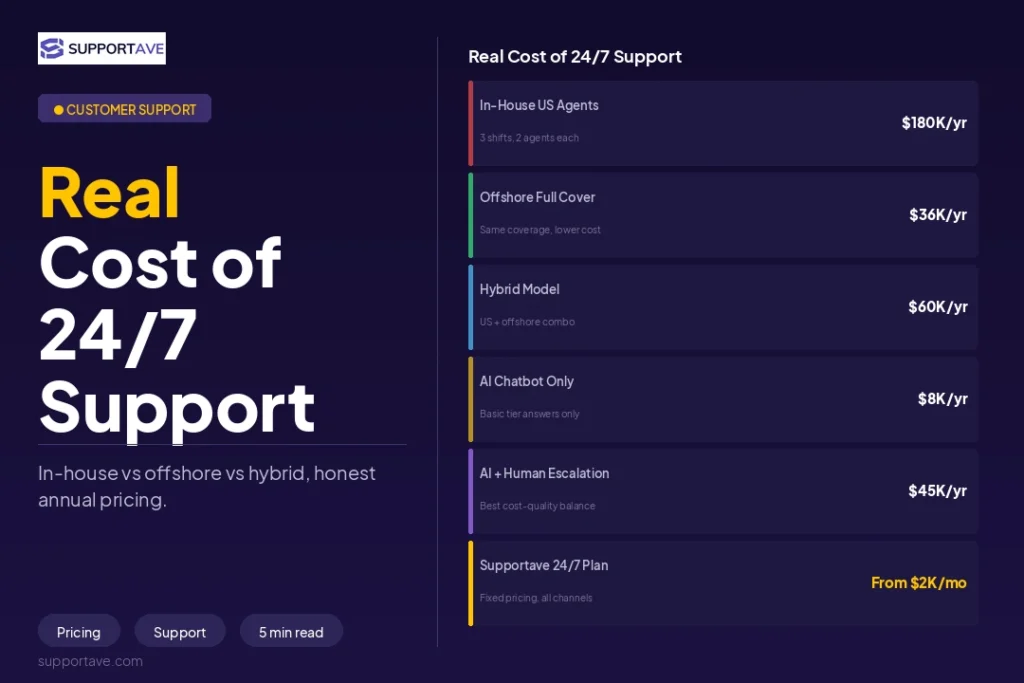
Businesses consistently underestimate what in-house 24/7 coverage actually costs because they compare outsourcing rates to a single agent’s salary rather than the full operational cost of a round-the-clock team.
To cover 24 hours, 7 days per week with one agent on shift at all times, you need a minimum of 4.2 full-time equivalents after accounting for days off, holidays, sick leave, and shift handover time. In practice, most businesses run at 5 FTEs for stable coverage with a buffer.
| Cost Component | Monthly Estimate (US/UK) | Notes |
| Agent salaries (5 FTEs at $15/hr) | $13,000 | Assumes $15/hr average, including night shift premiums |
| Employer payroll taxes and benefits | $2,600 to $4,000 | Typically 20 to 30% on top of salary |
| Management and team lead overhead | $1,500 to $3,000 | Supervisor time across three shifts |
| Hardware, software, and tooling | $500 to $1,500 | Helpdesk licences, telephony, monitoring |
| Recruitment and training (annualised) | $400 to $800 | Customer service turnover is typically 30 to 45% per year |
| TOTAL | $18,000 to $22,800 | Per month for genuine 24/7 in-house coverage |
Comparable 24/7 coverage from a quality outsourced partner with dedicated agents, trained on your brand, typically costs $3,500 to $6,000 per month for a small to mid-size business. The saving is not marginal. It is the difference between 24/7 support being financially viable and financially impossible.
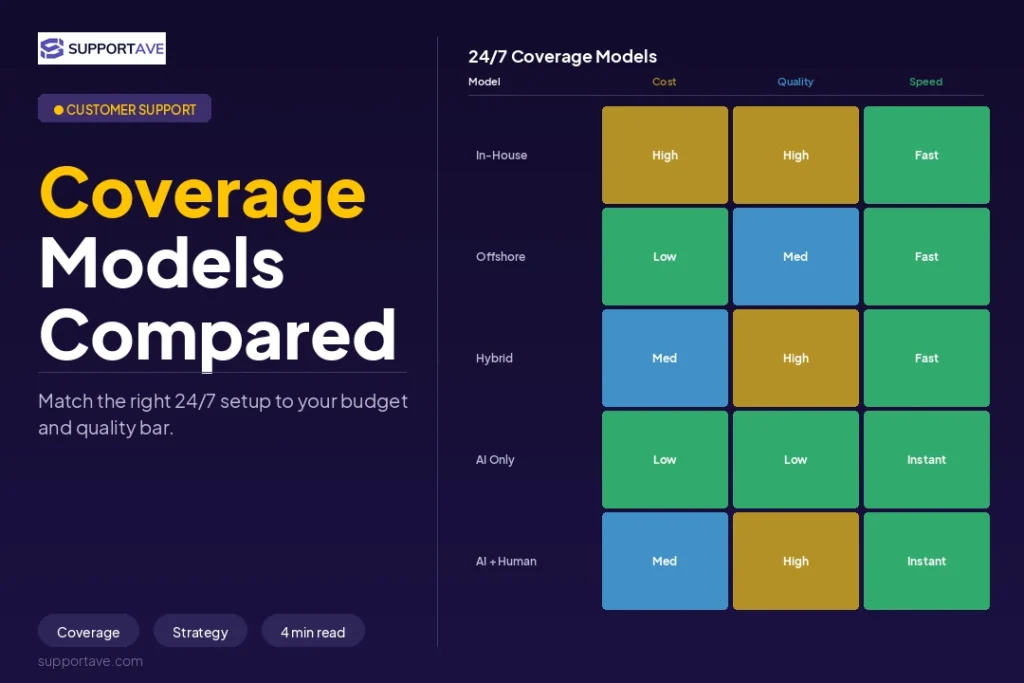
The Four Models for Delivering 24/7 Support
Model 1: Fully Outsourced to a BPO Partner
You hand off all support channels to an external provider who covers your brand 24 hours a day across chat, email, and phone. The provider supplies the agents, the infrastructure, the QA programme, and the reporting. This is the model most businesses mean when they say ‘outsource customer support’. Our guide on outsourcing without losing brand voice covers in detail how to maintain tone and quality consistency with this approach.
Best for: businesses whose support volume is consistent enough across the day that staffing your own off-hours team would be underutilised, businesses entering international markets, and businesses where the support function is not a core strategic differentiator.
Typical cost: $3,500 to $8,000 per month for dedicated agents covering all hours. Shared agent models start lower but sacrifice brand consistency.
Model 2: Hybrid, In-House Plus Outsourced Overflow
Your internal team handles peak hours (typically 8am to 8pm in your primary market) and manages escalations, complex queries, and high-value customer interactions. An outsourced team covers the remaining hours, weekends, and overflow during volume spikes.
This model is increasingly common because it preserves direct control over your most important customer interactions while dramatically reducing the staffing overhead of after-hours coverage. Global Response, in their 2026 guide on 24/7 support, specifically highlights the hybrid model as the most practical option for companies that want to eliminate after-hours gaps without burning out their in-house team.
Typical cost: $1,500 to $4,000 per month for the outsourced layer, depending on volume and channels covered.
Model 3: AI Chatbot for Routine Queries, Human Escalation for Complex Ones
An AI chatbot handles 65 to 80% of overnight inquiries automatically, covering FAQs, order status, basic troubleshooting, and lead capture. Anything the chatbot cannot resolve is flagged for the first available human agent in the morning. For the specific comparison of AI chatbots versus live agents across different use cases, our live chat vs AI chatbot guide covers the trade-offs in detail. The key caveat: a bot that cannot resolve an issue and does not offer a clear path to a human creates worse frustration than no bot at all. Escalation paths must be built from day one.
Typical cost: $29 to $150 per month for a well-configured AI chatbot platform. Higher if you need a custom RAG-powered implementation trained on your specific knowledge base.
Model 4: Extended Hours Rather Than True 24/7
For some businesses, the practical gap is not 24/7 but simply extending from 9-5 to 8am to 10pm, or covering weekends. This intermediate step captures the majority of the after-hours support demand without the full infrastructure overhead of round-the-clock staffing. If your analytics show that 80% of your after-hours contacts arrive between 8pm and midnight, a coverage extension to midnight costs a fraction of true 24/7 coverage and solves most of the problem.
Step-by-Step: How to Set Up 24/7 Support Without Building a New Team
- Analyse your current ticket data. Export support volume by hour of day and day of week for the past 90 days. Identify the specific time windows where response gaps are costing you most. You may find that 60% of your after-hours volume arrives in a 4-hour window. That changes your coverage requirements significantly.
- Define your channel priorities. Not every channel needs 24/7 coverage simultaneously. For most businesses, chat and email as the first channels to extend makes sense. Phone coverage requires more infrastructure and typically costs more per contact.
- Choose your model. Use the framework above: pure outsourcing for consistent high volume, hybrid for businesses with an existing team they want to protect from shift work, AI first for low-complexity ticket profiles where cost efficiency matters most.
- Select a provider and run a 30-day pilot. Start with one channel, ideally email or chat. Review 100% of tickets in the first two weeks rather than the standard QA sample rate. Identify gaps in brand voice, product knowledge, or escalation handling before scaling to full coverage.
- Set your SLAs before launch, not after. Define first response time targets by channel: under 1 minute for live chat, under 2 hours for email, and agree what escalation looks like when a ticket exceeds the threshold. Build these into your provider contract.
- Connect tools directly. Your outsourced team should work inside your existing helpdesk (Zendesk, Gorgias, Intercom), not a parallel system. Agents who can see full customer history, previous tickets, and CRM context from the first message provide meaningfully better experiences than agents starting from zero.
What 24/7 Support Does to Customer Metrics
The business case for always-on availability shows up in measurable ways:
- CSAT improvement: businesses that extend to 24/7 coverage typically see CSAT improve by 10 to 20 percentage points within the first 90 days, primarily by eliminating the frustration of next-day responses to urgent queries.
- First-contact resolution: when customers do not have to repeat their issue across multiple contacts over multiple days, FCR rates rise. The correlation between fast availability and higher resolution rates is consistent across the outsourcing industry.
- Revenue retention: for e-commerce and SaaS, after-hours support directly reduces churn from customers who would otherwise abandon during a purchase or trial without resolution. LiveChat data shows that 60% of customers are more likely to return to a website after a positive live chat experience.
Frequently Asked Questions
Do I really need 24/7 support if most of my customers are in one time zone?
Not necessarily. Analyse your ticket timestamps before making any decision. If 90% of your support contacts arrive between 8am and 10pm in your primary time zone, extended hours rather than true 24/7 coverage may be sufficient. True 24/7 staffing becomes essential when you have a meaningful international customer base, when your product is used at all hours (e-commerce, SaaS, entertainment), or when you are actively marketing to customers in multiple time zones.
What is the minimum team size needed for in-house 24/7 coverage?
To cover 24 hours, 7 days per week with one agent on shift at all times, you need a minimum of 4 to 5 full-time equivalents when accounting for days off, sick leave, and shift handover. This assumes a single-agent shift at all times. If your volume requires two agents simultaneously, double the headcount. Most small businesses find this floor unaffordable compared to outsourcing the same coverage for a fraction of the cost.
Can a chatbot really handle 24/7 support on its own?
For routine inquiries, yes. A well-configured AI chatbot can resolve 65 to 80% of overnight tickets involving order status, FAQs, basic troubleshooting, and contact information. What it cannot handle reliably: emotionally charged complaints, complex multi-step troubleshooting, billing disputes, and situations requiring access to account-specific data the bot has not been trained on. The critical design decision is not whether to use a chatbot but how to make escalation seamless when the bot hits its limits.
How long does it take to get an outsourced 24/7 support team operational?
A basic outsourced team handling email and chat can typically be operational within 2 to 4 weeks of signing. The timeline includes brand training, tool integration, knowledge base review, and initial QA calibration. Phone coverage typically takes longer to set up due to telephony configuration and deeper product knowledge requirements. Full-coverage launch with a pilot period beforehand typically runs 4 to 6 weeks from decision to stable operation.
What is the difference between shared agents and dedicated agents for 24/7 coverage?
Shared agents work across multiple client accounts simultaneously, handling whichever brand’s tickets arrive at any given moment. They are cheaper but provide weaker brand consistency and often less product-specific knowledge. Dedicated agents work exclusively on your account, develop deep product knowledge over time, and can maintain your specific brand voice reliably. For any business where how support sounds matters to the customer relationship, dedicated agents are the appropriate model even at the higher cost.
Supportave provides 24/7 dedicated customer support across chat, email, and call, with agents trained in your brand voice and integrated directly into your existing helpdesk tools. See our website chat support, call support, and email support services, or contact us to discuss your 24/7 coverage requirements.