
Why Startups Choose Outsourced Web Development Over In-House Teams
Hiring an in-house development team is the default assumption for most people who have not done it. The reality for most startups is that recruiting a single senior full-stack developer in the US or UK takes 4 to 8 weeks, costs $120,000 to $180,000 per year in salary alone, and requires months of onboarding before that person is contributing to core product work. Meanwhile, a comparable outsourced team can be operational in days, at 30 to 60 percent lower total cost, with a project manager already embedded in the engagement. This article explains the specific reasons startups choose outsourced web development, when outsourcing is the better model, and when it is not. If you are evaluating which development model fits your product requirements, our guide on what a full-stack web development agency does covers how a professional outsourced engagement is structured from discovery through to post-launch.
Quick Answer: Outsourced web development is the right choice for most startups because it reduces time-to-first-code from months to days, provides immediate access to full-stack expertise without the cost and risk of senior developer hiring, allows resource scaling without HR overhead, and lets founding teams stay focused on product validation and business development rather than managing a development function. According to Freshcode’s 2026 outsourcing analysis, outsourcing can reduce total development costs by 40 to 70% compared to building the same capability in-house.
The Real Cost of In-House Development for Startups
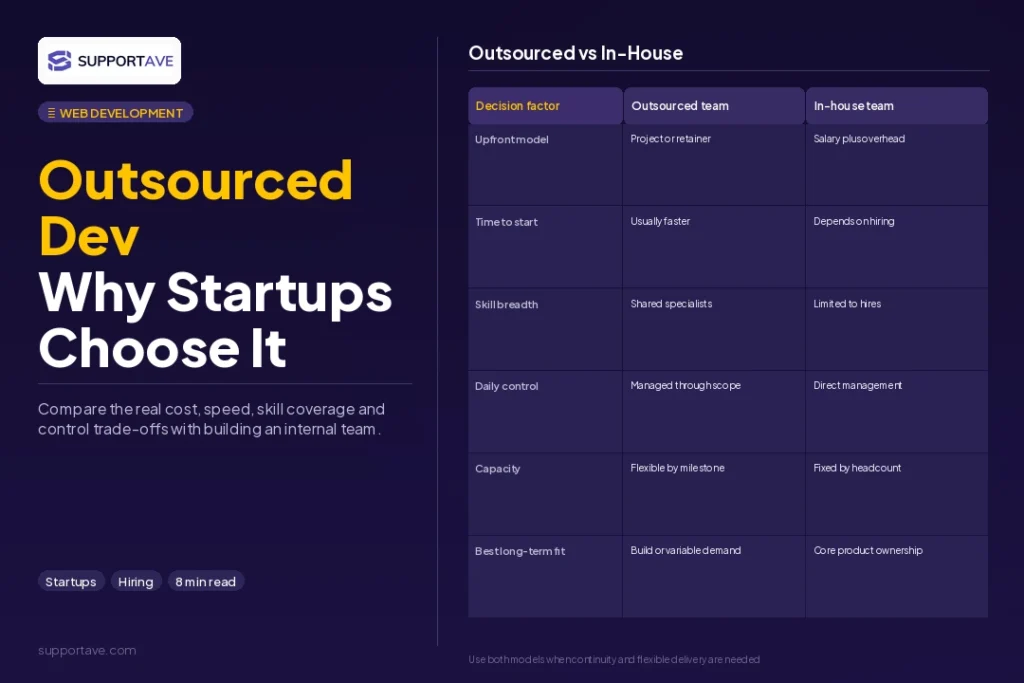
The comparison most startup founders make is wrong. They compare an outsourcing agency’s project quote to a single developer’s annual salary. The full comparison looks very different.
What in-house development actually costs for a startup building a web application:
- Senior full-stack developer in the US or UK: $120,000 to $180,000 per year in salary.
- Employer overhead (benefits, payroll taxes, equipment): adds 25 to 40% to base salary.
- Recruitment cost: the SHRM average cost to hire one employee is $4,700 before salary. For senior developers, this number is higher, particularly in competitive tech markets.
- Time-to-productivity: hiring takes 4 to 8 weeks, and onboarding a new developer to the codebase and your product domain typically takes a further 4 to 12 weeks. According to Freshcode’s 2026 analysis, in-house hiring means 2 to 4 months before a single line of product code is written.
- Single-person risk: one senior developer is a single point of failure. When they take holiday, fall ill, or resign, development stops. An outsourced team has redundancy built in.
Compare this to outsourcing. According to DevOptiv’s 2026 outsourcing guide, a standard outsourced web application typically costs $15,000 to $80,000. Eastern European teams cost $40 to $90 per hour. South Asian teams cost $12 to $75 per hour. An outsourced MVP can typically be delivered in 8 to 12 weeks from engagement start to launch, versus the 5 to 8 months a startup would spend just recruiting and onboarding an equivalent in-house team.
Why Outsourced Web Development for Startups Makes Strategic Sense
Speed to market is the primary advantage
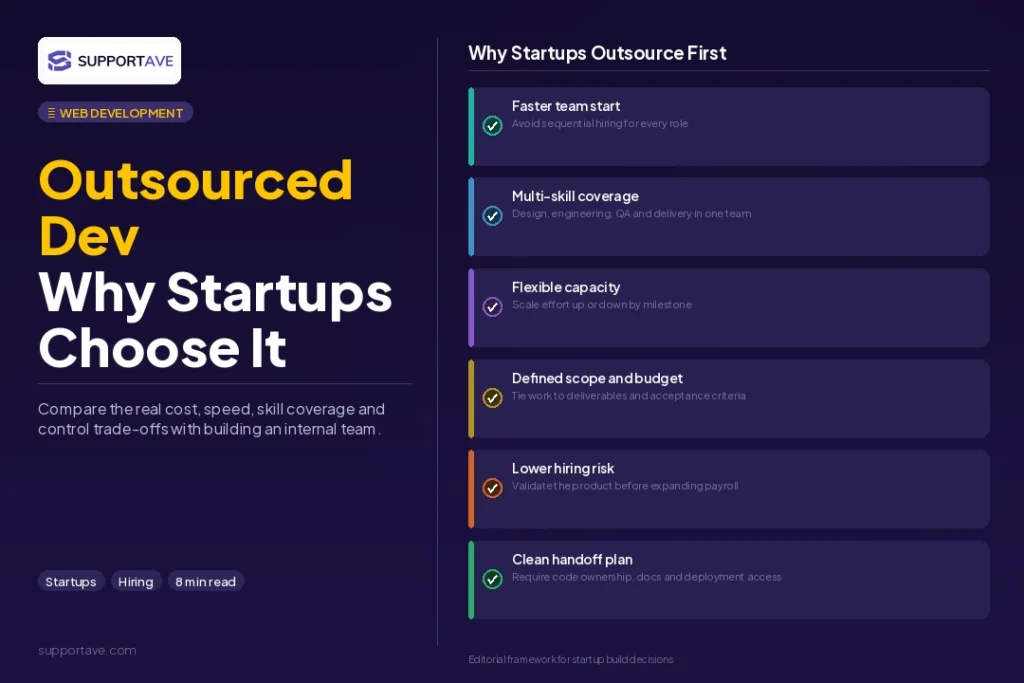
In a competitive market, a competitor with a running product has a structural advantage over one still hiring developers. According to Depechecode’s 2026 outsourcing analysis, an outsourced project can start within days of agreement compared to 6 to 12 weeks for recruiting and onboarding an in-house developer. For startups racing to validate a market or launch before a competitive window closes, that speed difference is frequently decisive.
A documented case from DevOptiv’s 2026 guide: a startup launched a production-ready ticketing platform in under two months using an outsourced team. The same scope with in-house hiring would have taken 5 to 7 months to reach the same point.
Immediate access to the right expertise without building a department
A startup building a web application in 2026 needs React or Next.js for the frontend, Node.js or Python for the backend, PostgreSQL or MongoDB for the database, AWS or Vercel for infrastructure, and QA capability across the stack. Hiring specialists for each of these domains is impractical for an early-stage company. An outsourced full-stack agency arrives with all of these capabilities already assembled and already working together. Our guide on custom web development services covers the six disciplines that a professional full-stack engagement includes: frontend, backend, database design, QA, DevOps, and post-launch support.
Resource scaling without HR complexity
A product launch requires more engineering resource than ongoing maintenance. A new feature sprint requires different skills than a security audit. In-house hiring cannot flex with these requirements without creating expensive overhead at each scale-up and HR complexity at each scale-down. Outsourcing accommodates this naturally. An outsourced team can absorb 10 developers for a 3-month launch sprint and transition to 2 developers for ongoing support without the startup ever processing a single redundancy.
Preserved capital for product validation
Runway is a startup’s most critical resource. An in-house developer at $150,000 per year burns $12,500 per month of runway before producing a single user. For a startup pre-revenue or pre-Series A, this is a significant portion of available capital. Outsourcing converts development from a fixed overhead to a variable cost tied directly to output: you pay for sprints delivered, not for engineers who are ramping.
According to Innowise’s 2026 in-house versus outsourcing analysis, for tech startups competing in fast-moving markets, the ability to compress delivery timelines and preserve capital while maintaining technical quality is often the difference between validating a business model and running out of runway before reaching meaningful traction.
Outsourced Web Development Startups: What to Look for in a Partner
Not all outsourcing partners deliver equal results. The criteria that matter most for startups:
- Full-stack capability: the partner should handle frontend, backend, QA, and DevOps as an integrated team, not as separate contractors you coordinate. Coordination overhead between separate specialisms is a significant time cost for a small startup team.
- Discovery process: a professional partner starts with a fixed-scope discovery phase before any build work begins. This produces a statement of work, a milestone timeline, and a clear scope that prevents the most common cause of startup development projects running over budget: scope changes mid-build that were not in the original agreement.
- Communication cadence: weekly demos, a shared project board, and async update channels. The right partner communicates like a member of your team, not like a vendor who surfaces occasionally to report on hours burned.
- Post-launch support: a launch is the beginning of the product lifecycle, not the end. Ensure post-launch bug fixing and feature work are accounted for in the engagement model before you sign.
- References from similar startups: a portfolio of large enterprise builds is not evidence of the right fit. Ask specifically for references from early-stage companies with similar technical scope to your product.
Our agency hiring checklist covers the 15 questions to ask any development agency before signing a contract, including the discovery process, ownership of code, QA process, and what happens if the project runs over timeline.
When Outsourcing Is NOT the Right Choice for a Startup
Outsourcing makes sense in most early-stage scenarios, but not all:
- When your core IP is the development methodology itself: if your competitive advantage is how you build software (a novel algorithmic approach, a proprietary development process, or a technical method that competitors would replicate if they saw your code), in-house development protects that IP more effectively than an outsourcing relationship.
- When speed of product iteration requires daily co-location: products that evolve through multiple daily design-code-test cycles sometimes perform better with a co-located team. This is a real constraint, though async-first outsourcing partnerships with strong communication structures narrow this gap significantly in 2026.
- When you have reached product-market fit and need to scale engineering velocity: the point at which startups typically transition from outsourcing to in-house hiring is after Series A, when the product has achieved traction and the engineering roadmap is stable enough to justify building a permanent team around it.
The Hybrid Model: Starting Outsourced and Transitioning In-House
The most common pattern for successful startups is not a binary choice between outsourced and in-house. It is a phased approach:
- Pre-seed to seed: outsource 100% of development. Ship the MVP, iterate based on user feedback, prove the product concept.
- Seed to Series A: hire your first in-house technical hire, typically a CTO or lead developer, who joins alongside the outsourced team and begins building internal technical capability.
- Series A onwards: build the in-house team around the areas where institutional knowledge matters most (core product architecture, security, data), while continuing to outsource specialist work or capacity augmentation during sprint peaks.
According to Striped Horse’s 2026 outsourcing guide, roughly 59% of all website development is now handled by outsourced teams. This is not because startups cannot hire developers. It is because outsourcing provides a faster, more capital-efficient path to a working product, and preserves the runway needed to validate whether that product is worth building a team around.
Frequently Asked Questions
How much does it cost to outsource web development for a startup?
The cost depends on scope and geography. A startup MVP with core features (user authentication, a database, basic API, and frontend) typically costs $15,000 to $40,000 through an Eastern European or South Asian outsourcing partner. A medium-complexity web application with integrations and a custom backend typically runs $40,000 to $100,000. Timeline: 8 to 16 weeks depending on scope. According to DevOptiv’s 2026 guide, a brochure site costs $3,000 to $15,000 and a custom SaaS platform starts at $60,000.
How do I ensure quality from an outsourced development team?
Require a fixed-scope discovery phase before build begins. Ask to see production code (not just screenshots) from previous projects. Run PageSpeed tests on live sites from their portfolio. Ask for two to three client references from similar-scope projects and call them. Insist on a shared project board with milestone transparency rather than updates that only come when you ask. Quality comes from process and accountability structures, not from geographic location.
Is outsourcing web development risky for a startup?
It carries specific risks that are manageable with the right structures: scope creep without a fixed discovery phase, ownership ambiguity without explicit IP clauses in the contract, communication gaps without a structured cadence, and quality variance without a defined QA process. All of these are contract and process decisions made before the engagement starts. A reputable agency will address all of them proactively. The risks of in-house hiring (time to hire, onboarding lag, single-person dependency, and fixed cost burn) are often less visible but frequently more expensive for early-stage startups.
When should a startup hire in-house developers instead of outsourcing?
After product-market fit, when the product is stable enough to justify building a permanent engineering function around it. Before that point, the rapid iteration cycles and capital efficiency demands of early-stage startup work are generally better served by an outsourced engagement. The signal is when your engineering roadmap extends more than 12 months out with high confidence: at that point, building institutional knowledge in an in-house team starts to deliver more value than the flexibility of outsourcing.
Does outsourcing web development affect IP ownership?
Not if the contract is written correctly. Any professional outsourcing engagement should include an explicit IP assignment clause stating that all code, designs, and deliverables become your property upon final payment. Ask for this clause by name before signing. Some agencies retain rights to reusable internal libraries or third-party components, which is standard practice, but the code built specifically for your product should be unambiguously yours. A reputable agency will confirm this in writing without hesitation.
Supportave builds web applications and websites for startups, from discovery through to post-launch support. Every project begins with a fixed-scope statement of work before any build begins. See our web development services or contact us to discuss your startup’s development requirements.