
LinkedIn Ads for B2B Lead Generation: Is It Worth the Higher CPC?
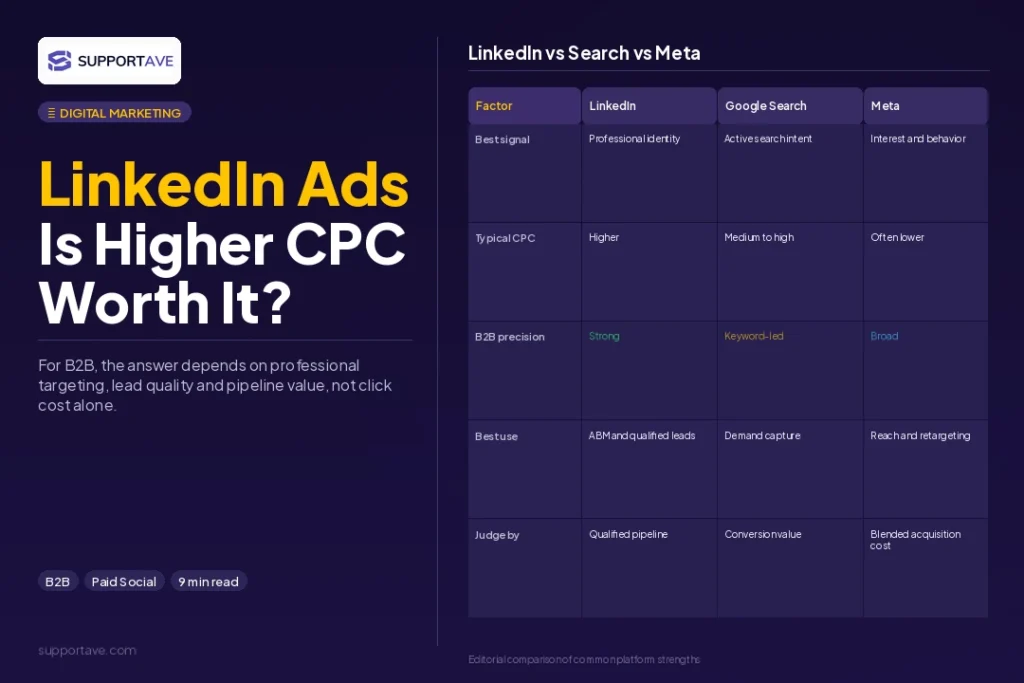
The objection comes up in every B2B marketing conversation about LinkedIn: the CPC is too high. At $5 to $22 per click depending on the audience and objective, LinkedIn is 3 to 6 times more expensive per click than Meta, and significantly more expensive than most Google Search terms outside competitive verticals. The question every B2B advertiser needs to answer is not whether LinkedIn is expensive. It is whether the cost per qualified lead and the downstream pipeline value justify what you pay per click. This article gives you the real 2026 data to answer that question for your business. For comparison with other paid channels, our Google Ads vs Meta Ads breakdown covers how B2B lead quality compares across the full paid media stack.
Quick Answer: LinkedIn Ads for B2B lead generation deliver an average 6.1% conversion rate (versus 3.75% for Google Search and 0.77% for Google Display), and B2B companies report 4.1 to 8.3x ROAS on well-structured LinkedIn campaigns (Stackmatix 2026). Despite higher CPC, LinkedIn’s cost per qualified lead is 28% lower than Google Ads for B2B on average because of superior professional targeting precision and higher downstream close rates. The breakeven is whether your average deal value justifies a CPL of $60 to $200+.
The Real Case for LinkedIn Ads B2B Lead Generation
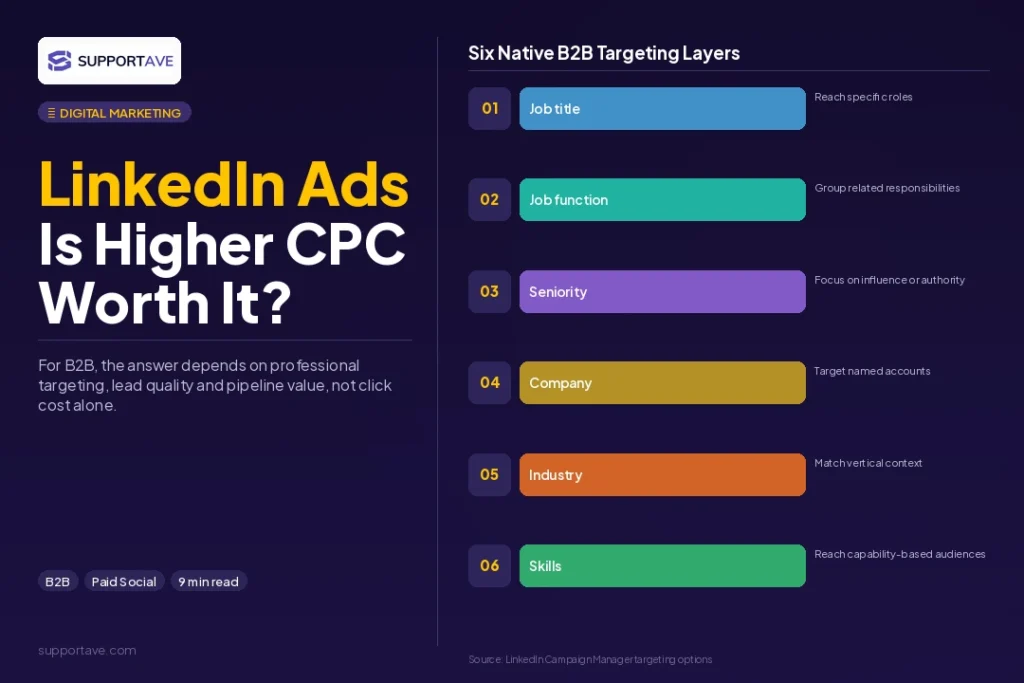
The case for LinkedIn in B2B advertising is not about CPC. It is about targeting precision that no other platform can replicate. On Google, you target keywords and infer intent. On Meta, you target interests and demographics and hope the professional you need is currently scrolling. On LinkedIn, you target by verified job title, company name, seniority level, years of experience, industry, company size, and professional skills: data that 1 billion+ members have actively maintained because it reflects their real professional lives.
That precision produces a fundamentally different audience quality. According to Digital Applied’s 2026 LinkedIn statistics analysis, despite higher CPC, LinkedIn’s cost per qualified lead is 28% lower than Google Ads for B2B campaigns, because fewer clicks are wasted on irrelevant traffic. And LinkedIn drives 80% of B2B social media leads, making it the dominant platform for social B2B lead generation by a margin no other social platform comes close to.
According to Dreamdata’s 2026 LinkedIn Ads Benchmarks report, LinkedIn now captures 41% of total B2B ad budgets, up 2 points year on year, while non-branded search dropped from 37% to 33% over the same period. B2B advertisers are making a data-driven reallocation toward LinkedIn, not a trend-driven one.
The Real Cost Numbers in 2026
| Metric | 2026 Benchmark | Notes |
| Average CPC (Sponsored Content) | $5 to $8 | Meet Lea analysis of thousands of B2B campaigns |
| Average CPC (C-Suite targeting) | $25 to $40 | Director+ runs 2 to 3x individual contributor rate |
| Average CPM | $31 median | Range: $15 to $75 depending on sector and targeting |
| Average CTR (Sponsored Content) | 0.44% to 0.65% | Thought Leader Ads: up to 2.68% CTR at $2.29 CPC |
| Lead Gen Form conversion rate | 10 to 15% | 3 to 5x higher than equivalent landing pages |
| Average CPL (broad B2B) | $60 to $150 | PPCBlogPro and Stackmatix 2026 data |
| Average CPL (financial services / SaaS) | $100 to $250 | Higher audience competition in these verticals |
| ROAS (well-structured campaigns) | 4.1 to 8.3x | B2B companies, Stackmatix 2026 benchmark |
| LinkedIn conversion rate (US) | 6.1% | vs 3.75% Google Search, 0.77% Google Display |
One data point from the LinkedIn B2B Institute is particularly useful for framing the CPC question: branded campaigns deliver $12.99 ROAS versus $0.68 for generic campaigns, an approximately 19x gap. LinkedIn’s effectiveness is not uniform: it rewards brand-prominent creative and thought leadership content significantly more than generic promotional messaging.
Lead Gen Forms vs Landing Pages: The Format Decision That Changes Everything
The single most impactful tactical decision in LinkedIn advertising is whether to send users to an external landing page or to use LinkedIn’s native Lead Gen Forms. The data in 2026 is clear:
- Lead Gen Forms: 10 to 15% conversion rate. Fields are pre-filled with LinkedIn profile data, eliminating the friction of manual entry. The mechanism removes the biggest conversion barrier, which is asking someone to type their details.
- External landing pages: 3 to 5% conversion rate. More friction, but more opportunity to provide context, demonstrate value, and qualify intent before a form is completed.
The trade-off is lead quality, not volume. Lead Gen Forms produce higher volume at lower CPL, but the frictionless experience means some leads are less qualified: a click-happy professional may submit a Lead Gen Form without genuine intent to engage. Landing page leads, having navigated away from LinkedIn and engaged with your content, typically show higher lead-to-opportunity conversion rates.
Practical recommendation: Use Lead Gen Forms for gated content offers (reports, webinars, checklists) where the primary goal is volume and you have a strong qualification workflow in your CRM. Use landing pages for demo requests and high-intent conversions where lead quality matters more than volume, and where your landing page is specifically designed for the LinkedIn audience landing on it.
The Format Breakdown: Which Ad Types Work Best
Sponsored Content (Single Image)
The workhorse format for LinkedIn B2B advertising. Appears natively in the feed. Average CTR of 0.42 to 0.65%. Best for thought leadership content, case study highlights, and offers with strong social proof. According to Digital Applied’s analysis, Thought Leader Ads (running Sponsored Content from a personal profile rather than a company page) deliver a median 2.68% CTR at $2.29 CPC versus 0.42% CTR at $13.23 CPC for standard single-image ads. This is one of the most underused formats in B2B LinkedIn advertising.
Video Ads
Average CTR slightly above standard at 0.44%. Video ads consistently underperform on direct CTR but outperform on brand recall and downstream conversion rate. According to a 2024 LinkedIn internal study, video ads generate 5 times more comments than static image ads among B2B audiences. Keep videos under 30 seconds for awareness objectives and under 90 seconds for consideration content.
Conversation Ads (Message Ads)
Delivered directly to LinkedIn inbox with 15 to 25% open rate. Cost is billed per send, not per click, which makes them expensive per contact but potentially the highest quality format for high-value offers targeting a very precise, small audience. Conversion rates on highly targeted Conversation Ads consistently outperform feed formats for premium offers.
Targeting Strategy: How to Build a B2B LinkedIn Audience
LinkedIn’s targeting precision is its primary competitive advantage. The most effective targeting approaches for B2B lead generation:
- Job function plus seniority: target your job function category (Marketing, Sales, Finance, IT) and layer on seniority levels (Senior, Manager, Director, VP, C-Suite). This is the most reliable way to reach decision-makers without over-narrowing your audience.
- Company size filter: for mid-market B2B, target 200 to 10,000 employees. Above 10,000 adds complexity and longer sales cycles without proportionally better conversion rates for most B2B service businesses.
- Matched audiences: upload your CRM list or target account list and match it to LinkedIn member profiles. This account-based targeting reaches your exact prospect list with LinkedIn’s full creative and format options.
- Retargeting: target users who have visited your website (via LinkedIn Insight Tag), engaged with your content, or watched your video ads. According to Meet Lea’s benchmark analysis, LinkedIn retargeting produces CPL 50% lower than prospecting campaigns. It is chronically underbudgeted in most accounts.
Recommended audience size: 50,000 to 500,000 for lead generation campaigns. Below 50,000, delivery suffers and CPCs spike. Above 500,000, precision drops and you may pay for impressions from audiences who do not match your ICP.
Budget and Expectations: What You Need to Test Properly
LinkedIn Ads require a meaningful minimum budget to generate statistically useful data. Most LinkedIn advertising guides, including PPCBlogPro’s 2026 B2B guide and Stackmatix’s playbook, recommend a minimum of $3,000 to $5,000 per month for 60 to 90 days to identify winning audiences, creatives, and offers before scaling. Below $1,000 per month, data accumulates too slowly to make informed decisions. For comparison, our Meta Ads mistakes article covers the same principle: budget that is too thin prevents any platform’s algorithm from optimising effectively.
What to expect in the first 30 days:
- Days 1 to 14: data collection. High CPL is normal. Avoid making significant targeting or creative changes during this window.
- Days 15 to 30: first optimisation signals. Identify which audience segments are driving lower CPL. Pause underperforming ad variations and allocate more budget to the better-performing ones.
- Days 30 to 60: sustainable performance baseline. CPL should be stabilising. This is when you can make informed decisions about scaling, changing ad format, or testing new audience segments.
LinkedIn Ads vs Google Ads for B2B: How to Allocate
The most effective B2B paid media programmes in 2026 use LinkedIn and Google for different jobs in the funnel, not as alternatives. LinkedIn builds pipeline at the top and middle of the funnel by reaching decision-makers who are not yet searching for your category. Google Search captures demand at the bottom of the funnel by intercepting those same decision-makers when they are actively researching solutions.
A practical allocation framework for a B2B business with a $10,000 monthly paid media budget:
- $6,000 to LinkedIn: Sponsored Content for awareness and consideration, Lead Gen Forms for demand capture, retargeting for prospects already in your pipeline.
- $4,000 to Google Search: high-intent branded terms, category terms where decision-makers are actively searching, competitor terms where relevant.
Adjust this ratio based on your average deal value and sales cycle. For enterprise deals above $50,000 ACV with a 6 to 12 month sales cycle, LinkedIn’s brand-building role throughout the long consideration period justifies a higher allocation. For SMB deals below $10,000 ACV with a shorter cycle, Google Search captures more of the immediate intent.
Frequently Asked Questions
Is LinkedIn advertising worth it for small B2B businesses?
It depends on your deal value and customer profile. LinkedIn’s minimum effective budget is $3,000 to $5,000 per month for meaningful testing. If your average deal value is below $5,000, the CPL on LinkedIn may be difficult to justify against revenue. If your average deal value is $10,000 or above, and your customers are senior professionals or business owners, LinkedIn’s targeting precision and lead quality typically produce a positive ROI that outperforms cheaper alternatives that generate higher volumes of lower-quality leads.
What is a good CPL target for LinkedIn B2B campaigns?
According to Stackmatix’s 2026 LinkedIn B2B guide, a CPL of $150 to $400 is efficient if your lead-to-opportunity conversion rate exceeds 15%. The more useful metric is cost per pipeline opportunity (how much you spend to generate a qualified sales conversation) rather than CPL (how much you spend to generate a form submission). A $300 CPL that produces a 20% lead-to-opportunity rate is significantly better than a $50 CPL from Meta that produces a 3% rate.
Which LinkedIn ad format generates the most B2B leads?
Lead Gen Forms with Sponsored Content consistently deliver the highest volume of leads at the lowest CPL for most B2B companies. Conversation Ads (Message Ads) often produce higher-quality leads with stronger downstream conversion rates but at higher cost per contact. The right format depends on your objective: Lead Gen Forms for volume and gated content, Conversation Ads for high-value, high-intent conversions targeting a small, well-defined audience.
How does LinkedIn Accelerate compare to manual campaign setup?
LinkedIn Accelerate is the AI-driven campaign type LinkedIn launched in 2025 and expanded in 2026. It handles audience targeting, bidding, and creative placement automatically, similar to how Performance Max works in Google Ads. Early data from advertisers using Accelerate shows it outperforms Classic manual campaigns for most B2B lead generation objectives, particularly for advertisers who do not have the time or expertise to manage detailed audience segmentation. The trade-off is the same as with Google’s automation: less transparency and less control over where your ads appear.
Do LinkedIn Ads work for service businesses, not just software companies?
Yes, and professional services businesses often see stronger results than SaaS companies because the targeting precisely matches their client profile. Consultancies, agencies, legal firms, HR firms, financial services, and digital marketing agencies consistently report strong LinkedIn performance. The key is specificity in targeting: define your ideal client profile by job title, company size, and industry before launching, rather than targeting broad professional audiences and hoping the right people see the ad.
Supportave manages LinkedIn, Google, Meta, and TikTok ad campaigns with full audience strategy, creative development, and CRM-connected reporting. See our digital marketing services or contact us to discuss your B2B paid media strategy.