
What Is ROAS and How to Improve It for Your Google Ads Campaigns?
ROAS is the number every paid media team reports to leadership, but very few businesses know how to move it deliberately. Most campaigns plateau at a mediocre 2x or 3x return and stay there, not because improvement is impossible, but because the levers are not well understood. This guide explains what ROAS is, how to calculate your break-even point, what good looks like by industry, and seven proven strategies to lift it in 2026. If you are running Google Ads alongside Meta campaigns, our Google Ads vs Meta Ads breakdown covers how ROAS compares across the two platforms and why the same metric can have very different implications on each.
Quick Answer: ROAS stands for Return on Ad Spend. The formula is Revenue from Ads divided by Ad Spend. A 4:1 ROAS means you earned $4 for every $1 spent. The median Google Ads ROAS across all industries sits at roughly 2:1 according to Ryze AI’s 2026 analysis of $500M+ in managed spend. Top-performing accounts consistently achieve 4:1 or higher. The strategies that move it most are: fixing conversion tracking, refining negative keywords, improving landing page relevance, shifting to Target ROAS bidding once sufficient data exists, and combining audience layers.
ROAS vs ROI: The Difference That Actually Matters
ROAS and ROI are frequently conflated, but they answer different questions and should drive different decisions.
ROAS measures ad efficiency: revenue generated per dollar of ad spend. It lives inside the ad platform and tells you whether a specific campaign, ad group, or keyword is generating revenue relative to what it costs.
ROI measures business profitability: it factors in cost of goods, overheads, and all other costs beyond ad spend. A campaign with a 5:1 ROAS can still be unprofitable if your gross margin is 15%.
The practical rule: use ROAS to optimize media decisions daily and compare channel or campaign performance. Use ROI to assess whether the business is actually making money and to justify budget allocation across quarters. According to Attribution’s 2026 guide on Google Ads profitability, if you are managing budget across multiple channels or reporting to a CFO, ROI is the number that matters, and the only way to calculate it cleanly is to unify spend and revenue data across the full customer journey, not just the last click.
How to Calculate ROAS (With a Worked Example)
The formula is straightforward.
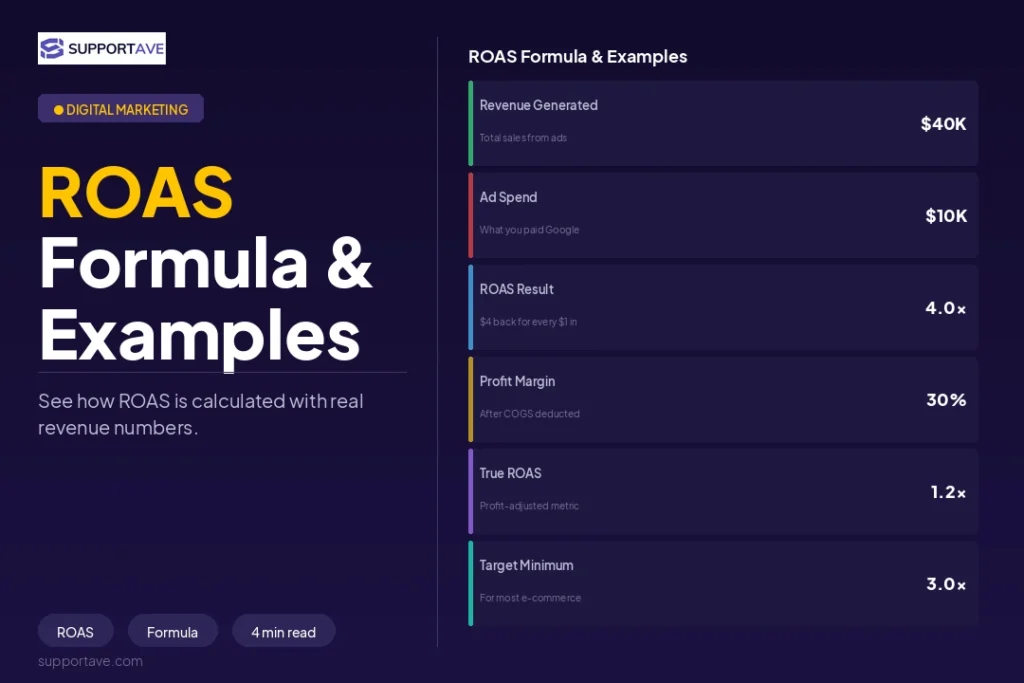
ROAS = Total Revenue from Ads / Total Ad Spend
Example: You spend $5,000 on Google Ads in May and the campaigns generate $22,000 in attributed revenue. Your ROAS is $22,000 / $5,000 = 4.4x, or 440%.
What you also need to calculate: your break-even ROAS. This is the minimum return required to cover all costs, including cost of goods, fulfilment, and transaction fees. Without knowing your break-even point, you cannot tell whether a 3x ROAS is healthy or a slow bleed.
Break-even ROAS formula: 1 divided by your gross margin percentage. If your gross margin after returns and fulfilment is 35%, your break-even ROAS is 1 / 0.35 = 2.86. Any campaign running below 2.86x is losing money on every sale. Any campaign above 2.86x is contributing profit.
Important caveat: E-commerce ROAS dropped to 2.87x in 2026, a 4% year-over-year decline driven by rising CPMs and iOS privacy restrictions, according to Improvado’s 2026 PPC analysis. The average is barely above break-even for many businesses. Knowing your own break-even is more actionable than benchmarking against an industry average that may not reflect your margin structure.
ROAS Benchmarks by Industry in 2026
| Industry | Typical ROAS Range | Notes |
| E-commerce (general) | 2.5x to 4.5x | Average dropped to 2.87x in 2026, per Improvado |
| Beauty and personal care | 3.0x to 8.0x | High-intent search campaigns can reach 8x |
| SaaS and software | 1.5x to 3.5x | LTV model often justifies lower short-term ROAS |
| B2B services | 1.5x to 4.0x | Pipeline ROAS often more relevant than immediate revenue |
| Retail and fashion | 3.0x to 6.0x | Retargeting and seasonal peaks lift the average significantly |
| Healthcare and wellness | 2.0x to 5.0x | High compliance requirements constrain ad formats |
| Travel and hospitality | 3.0x to 7.0x | Strong seasonal variance |
These are ranges, not targets. Your break-even ROAS, your customer lifetime value, and your growth stage all affect what a good ROAS means for your specific business. A SaaS company with 80% gross margins and a 24-month average customer lifespan can profitably run a 1.8x ROAS on acquisition campaigns. An e-commerce brand with 25% margins and high churn cannot.
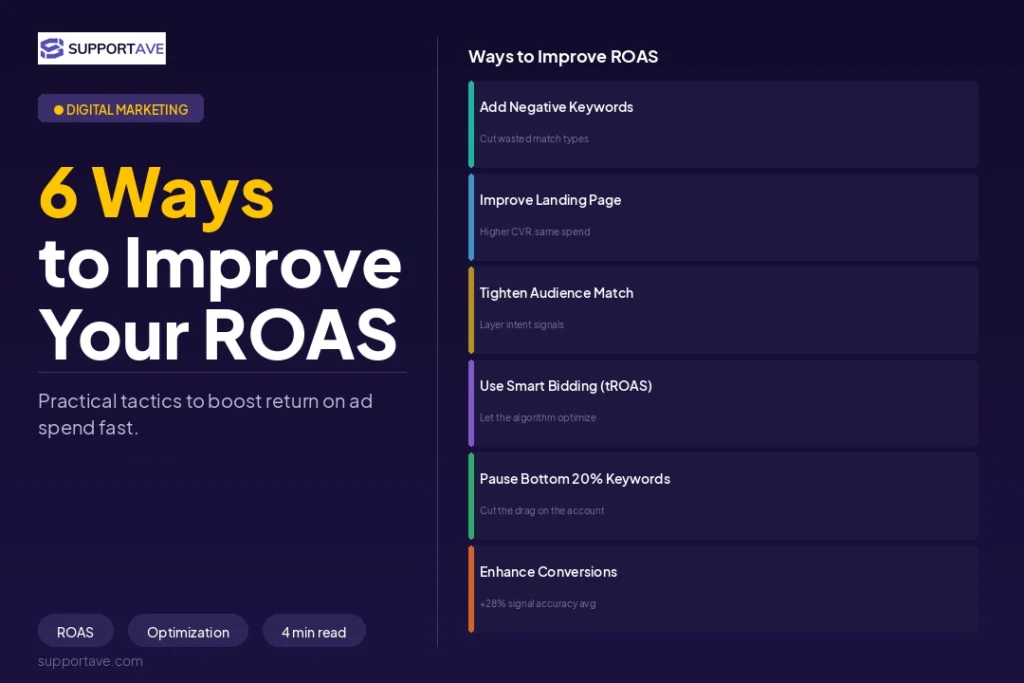
The 7 Strategies That Actually Move ROAS
1. Fix Conversion Tracking First
If your tracking is broken or incomplete, Smart Bidding has no signal to optimise toward and your reported ROAS is fiction. Before any optimisation work, verify that Google Ads conversion tracking is firing correctly on every conversion action, that conversion values are being passed accurately, and that Enhanced Conversions is enabled to recover attribution lost to iOS privacy restrictions. Our conversion tracking setup guide walks through the exact GTM configuration to get this right.
2. Calculate and Set Your Target ROAS Correctly
Most advertisers set target ROAS either too aggressively (throttling reach) or too loosely (generating revenue below break-even). The right approach: calculate your break-even ROAS, then set your target 20-30% above it to build in a profit margin. If your break-even is 2.86, a starting target ROAS of 3.5 is reasonable. Do not set targets above your actual recent performance by more than 15-20%, or Google’s algorithm will restrict reach so aggressively that conversion volume drops and the algorithm cannot learn.
Prerequisites for Target ROAS bidding: a minimum of 15 conversions in the past 30 days, and ideally 30 or more with accurate conversion values. Below that threshold, start with Maximise Conversion Value to gather the signal the algorithm needs before switching to a constrained bidding strategy.
3. Build a Negative Keyword List That Actually Works
Every irrelevant search query your ad appears on costs money and produces no revenue. In competitive categories, 15-25% of paid traffic can be non-commercial intent: people researching, not buying. A systematic negative keyword audit, starting with Search Terms reports to identify queries driving clicks without conversions, and building exclusion lists at campaign and account level, is one of the fastest ROAS improvements available at no additional spend.
4. Align Landing Pages with Ad Intent
Sending a user who clicked an ad for ‘custom web development for healthcare companies’ to a generic web development homepage is the most common landing page mistake. According to multiple 2026 conversion benchmarks, personalised landing pages convert at 3x the rate of generic pages. Create dedicated landing pages for your highest-spend ad groups, matching the headline, the offer, and the visual layout to the specific intent of the search query that brought the user there.
5. Layer Audiences on Top of Keywords
Running keyword campaigns without audience layers leaves significant ROAS improvement on the table. Three audience overlays that consistently improve returns:
- Remarketing Lists for Search Ads (RLSA): bid more aggressively when someone searching your keyword has previously visited your site. This audience has already shown interest and converts at a meaningfully higher rate.
- Customer match: upload your existing customer email list and exclude them from acquisition campaigns (avoiding wasted spend on people who already bought) while increasing bids when they search for expansion products.
- In-market audiences: layer Google’s in-market segments on top of keywords to concentrate spend on users who are actively researching your category. According to the 2026 advanced ROAS tactics guide from ALM Corp, triple-layered audiences combining lookalikes, in-market segments, and relevant keyword intent typically deliver 3 to 4 times better ROAS than untargeted prospecting.
6. Use Performance Max Strategically, Not Universally
Performance Max is powerful but not a replacement for well-structured Search campaigns. PMax handles broad discovery across all Google channels (Search, Shopping, Display, YouTube, Discover), which is valuable for e-commerce and reach-focused campaigns. But PMax operates as a black box and can cannibalise branded search traffic if brand exclusions are not set correctly. The most effective account structure in 2026: dedicated Search campaigns for your highest-value, highest-intent keywords, with PMax handling broader discovery and Shopping traffic, properly segmented by product margin.
7. Scale Incrementally, Not in Jumps
Doubling a campaign budget overnight resets the learning phase and typically produces a temporary ROAS drop of 20-35% as the algorithm re-calibrates to the new spend level. The proven scale protocol: increase budget by 10-20% every 3 to 5 days while monitoring ROAS against your target. At each step, give the algorithm 5 to 7 days to re-stabilise before the next increase. The total time to double a campaign budget without losing ROAS efficiency is typically 4 to 6 weeks, not 2 hours.
What a Good ROAS Improvement Timeline Looks Like
Realistic expectations for a well-managed Google Ads account optimisation:
- Week 1 to 2: Conversion tracking audit and fixes. No ROAS improvement expected yet. This is infrastructure work.
- Week 3 to 4: Negative keyword implementation and landing page alignment. First signs of improved CPA and conversion rate.
- Week 5 to 8: Audience layer implementation and Target ROAS activation once data thresholds are met. ROAS begins trending toward target.
- Week 9 to 12: Incremental budget scaling with stable ROAS. This is the phase where the improvement compounds.
According to Ryze AI, whose clients manage $500M+ in annual Google Ads spend, their accounts average 3.8x ROAS within 6 weeks of onboarding. The difference versus underperforming accounts is not budget size. It is tracking accuracy, targeting discipline, and the patience to let Smart Bidding learn before making changes.
Frequently Asked Questions
What is a good ROAS for Google Ads in 2026?
A commonly cited benchmark is 4:1, meaning $4 in revenue for every $1 spent. But the right ROAS depends entirely on your gross margins, your business model, and your customer lifetime value. For a high-margin SaaS business with strong retention, a 1.8x ROAS on a customer acquisition campaign can be highly profitable. For a low-margin product with high fulfilment costs, even a 5x ROAS might not cover all costs. Always calculate your break-even ROAS before benchmarking against industry averages.
What is the difference between ROAS and ROI?
ROAS measures revenue generated per dollar of ad spend, purely within the advertising context. ROI factors in all business costs, including cost of goods, overheads, and operational expenses, to measure true profitability. A campaign can have a strong ROAS and negative ROI if the product margin is thin. ROAS is the right metric for daily campaign decisions. ROI is the right metric for budget allocation and business-level profitability assessment.
How much data do I need before switching to Target ROAS bidding?
Google recommends a minimum of 15 conversions in the past 30 days at the campaign level before activating Target ROAS, and 30 or more is strongly preferred for reliable algorithm performance. Below that threshold, the algorithm lacks sufficient conversion signal and will bid erratically, often producing worse ROAS than manual bidding. Start with Maximise Conversion Value to build the data, then switch to Target ROAS once the threshold is met.
Why does my ROAS drop when I increase budget?
When you increase budget significantly (more than 20% in a short period), Google resets the campaign’s learning phase. During learning, bidding is less efficient as the algorithm recalibrates to the new spend level. This typically produces a temporary ROAS dip of 15-30% that resolves within 7 to 14 days. To avoid this, scale budget by 10-20% increments every 3 to 5 days rather than making large single increases.
Can Target ROAS bidding hurt campaign performance?
Yes, if the target is set incorrectly. Setting a target significantly above your recent actual ROAS causes Google to restrict reach aggressively, reducing impression volume and conversion opportunities in pursuit of an efficiency target it cannot reach with your current creatives and landing pages. Set your initial Target ROAS no more than 10-20% above your current baseline, then raise it gradually as the account improves.
Supportave manages Google Ads campaigns with full conversion tracking setup, audience strategy, and ROAS-focused optimisation. See our digital marketing services or contact us to discuss your paid search strategy.