
How to Build a Customer Support Team for an E-Commerce Store
Customer support is not a back-office function for an e-commerce store. It is the moment your brand promises are tested in real time, on a customer who is frustrated, confused, or mid-purchase. The difference between a one-star review and a repeat buyer often comes down to how fast and how well your support team responds. This guide covers how to build a customer support operation that scales with your store, from your first hire through to a structured multi-channel team. If you are also considering whether to build in-house or outsource, our complete customer support outsourcing guide covers the model, cost, and partner selection decisions in detail.
Quick Answer: Build your e-commerce support team in three stages: start with one strong generalist agent for email and chat, add a team lead when you reach three agents, and layer in a QA analyst and AI-assisted tooling by the time your order volume exceeds 500 orders per day. According to Shopify research, stores that invest in structured support consistently outperform competitors on retention and lifetime customer value. The tools, the SOPs, and the escalation path matter as much as the headcount.
Stage 1: The First Hire (0 to 100 Daily Orders)
Below 100 daily orders, a single experienced support agent covering your primary channels, email and live chat, is the right starting point. You do not need a team. You need one person who is genuinely good at the job.
What to look for in your first hire:
- Strong written communication: most e-commerce support happens through email and chat. Your agent needs to write clearly, warmly, and concisely under time pressure.
- Empathy under pressure: your customers contact support when something has gone wrong. The ability to de-escalate a frustrated customer and find a resolution without escalating the situation is a skill, not a personality trait. Look for it explicitly in the interview.
- Product and logistics literacy: agents who understand inventory, shipping carriers, tracking processes, and return policies can answer common questions accurately without needing to escalate every ticket.
- Tool fluency: familiarity with a helpdesk (Gorgias or Zendesk for Shopify stores), basic spreadsheet skills, and comfort learning new software quickly.
According to Shopify’s research, the wrong support hire costs a business up to $240,000 when you factor in the full impact on customer experience, reviews, and the cost of replacing them. Take your time on the first hire. For the right person, a well-hired customer support agent frees 15 to 20 hours of owner time per week, which at a $100 opportunity cost translates to $6,000 to $8,000 per month in reclaimed capacity for revenue-generating work. If you are running a Shopify store, also see our Shopify store development guide on how your store’s technical foundation affects how much support volume you generate in the first place.
Stage 2: The First Team (100 to 500 Daily Orders)
Team structure at this stage
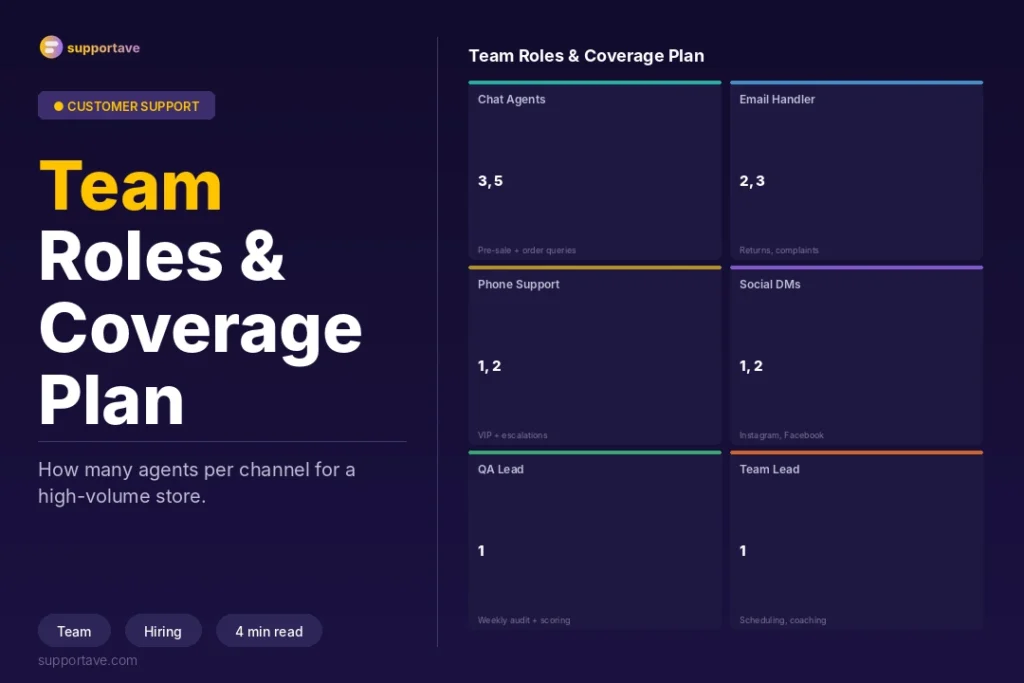
At 100 to 500 daily orders, you typically need 3 to 5 agents depending on your average handle time per ticket and the complexity of your product. The most effective structure:
- Tier 1 agents (2 to 3): handle the high-volume, routine tickets. Order status, tracking, basic returns, FAQ responses. These can be templated and handled quickly.
- Tier 2 agent (1): handles escalations from Tier 1, exceptions, complaints, refund disputes, and anything requiring judgment outside standard policy.
- Team lead (1, promoted from your best Tier 1 agent): manages the daily queue, monitors response times, and delivers informal coaching. Add this role when you reach 3 agents.
The Gartner research from 2026 is relevant here: 91% of customer service leaders are under pressure to implement AI this year, but Gartner also predicts that 50% of companies that cut staff due to AI will end up rehiring by 2027. At this stage, the right model is AI handling volume and humans handling judgment, not AI replacing your team.
The tool stack that matters
For an e-commerce store at this stage, your tool decisions have a larger impact on performance than headcount. The critical choices:
- Helpdesk: Gorgias is the strongest choice for Shopify stores because it reads directly from Shopify order data, meaning agents can see order status, tracking, and purchase history without leaving the ticket. Zendesk is more powerful for complex multi-brand or enterprise setups. For most Shopify stores, Gorgias is the better fit.
- Macros and templates: build response templates for your top 10 ticket types before your second agent starts. Inconsistent responses from different agents on the same issue erode trust faster than slow responses do.
- Self-service knowledge base: a well-built help centre reduces ticket volume by 15 to 25% by letting customers find answers before contacting support. Prioritise your 10 most frequently asked questions as articles.
- AI-assisted drafting: tools like Gorgias AI or Help Scout AI can draft ticket responses for agent review. This reduces handle time by 20 to 35% on routine tickets without reducing quality.
Stage 3: Scaling Past 500 Daily Orders
Above 500 daily orders, support volume becomes genuinely complex to manage without structured QA, clear escalation paths, and a decision about whether to staff up in-house or outsource.
Add a QA analyst
The QA analyst role is the one most stores skip, and it is consistently the decision that separates support teams with improving CSAT from teams with stagnant CSAT. At this order volume, a QA analyst reviews a sample of tickets weekly, coaches agents on specific responses, identifies policy gaps, and tracks CSAT trends. Without this role, support quality tends to drift downward as volume grows.
Define your escalation path clearly
Every ticket type should have a documented resolution path: who handles it at Tier 1, what triggers escalation to Tier 2, and what triggers escalation to a manager or the store owner. Without this, escalation becomes arbitrary and agents default to over-escalating to avoid making decisions.
Evaluate outsourcing for overflow and after-hours
At this volume, after-hours and overflow coverage becomes economically meaningful. A qualified outsourcing partner can cover your chat queue overnight and during peak periods at significantly lower cost than staffing the same coverage in-house. For the specific comparison of 24/7 in-house versus outsourced coverage costs, our 24/7 customer support guide walks through the numbers in detail.
The SOPs Your Team Needs Before Going Live
Standard Operating Procedures are what turn a group of individuals into a consistent support team. Build these before your first agent handles a live ticket, not after your first escalation:
- Brand voice guide for support: three examples each of on-brand and off-brand responses. Not a marketing style guide: a support-specific one that shows what to say to a frustrated customer.
- Return and refund policy: the exact conditions, the exact process, and the exact authority each tier has to approve exceptions.
- Escalation criteria: specific conditions that trigger escalation rather than agent judgment calls about what feels too hard.
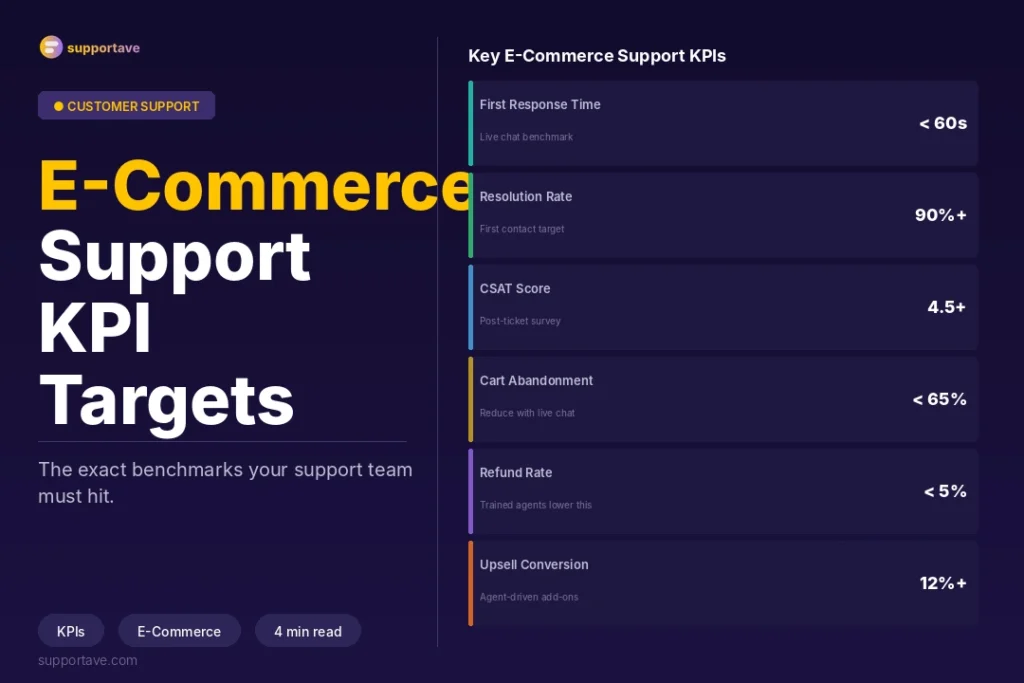
- Response time SLAs by channel: email under 2 hours, live chat under 2 minutes, social DMs under 4 hours. Agreed in writing before your team starts.
- Canned responses for top 10 ticket types: templated but not robotic. Each should leave space for a one-line personalisation at the opening.
In-House vs Outsourced: The Decision Framework
| Scenario | Recommended Model | Reason |
| Under 50 tickets/day | In-house, part-time | Volume too low for outsourcing to be cost-effective |
| 50 to 200 tickets/day | In-house first agent, consider outsourcing after-hours | Building product knowledge in-house first pays off |
| 200 to 500 tickets/day | Hybrid: in-house for complex, outsourced for overflow | Reduces burn on in-house team, covers peaks |
| 500+ tickets/day | Outsourced dedicated team with QA, in-house escalation layer | Volume justifies a full outsourced operation |
| Seasonal spikes (e.g. BFCM) | Shared outsourced agents for the spike period | Hiring in-house for seasonal demand is impractical |
When outsourcing wins: According to Mascallnet’s 2026 Shopify outsourcing analysis, Shopify brands that outsource support consistently achieve 2 to 3 times faster response times and significantly lower cost per ticket than equivalent in-house teams at comparable quality levels, particularly when the outsourced team is integrated directly into Gorgias or Zendesk rather than running a parallel system.
Key Metrics to Track From Day One
- First Response Time (FRT): the time between a customer sending a ticket and receiving a first reply. Target under 2 hours for email, under 2 minutes for live chat.
- First Contact Resolution (FCR): the percentage of tickets resolved on the first reply without the customer needing to follow up. Target 75 to 85% for routine ticket types.
- CSAT (Customer Satisfaction Score): post-resolution survey score, typically 1 to 5 stars. Target 4.2 and above. Below 4.0 consistently means a quality or training problem.
- Tickets per Order: the number of support contacts per order processed. A high ratio signals product, fulfilment, or communication problems upstream of support itself.
- Handle Time: average time to close a ticket. Track this to identify agents who are struggling with efficiency and ticket types that need better templates.
Frequently Asked Questions
When should I hire my first customer support agent?
The clearest signals: you are spending more than 10 hours per week on support yourself, your response time is regularly exceeding 4 hours for email, or your CSAT or review scores are declining because of support quality. For most Shopify stores, this happens between 30 and 80 daily orders. At that volume, a part-time agent (20 hours per week) is enough to start, with a view to full-time within 3 to 6 months as volume grows.
What helpdesk is best for a Shopify support team?
For most Shopify stores, Gorgias is the strongest choice because it connects directly to your Shopify admin, showing order data, tracking numbers, and purchase history inside every ticket. This alone reduces handle time significantly. Zendesk is better if you need more complex routing rules, multi-brand management, or deep integrations with other enterprise tools. For stores under $1M in annual revenue, Gorgias pricing is also significantly lower than Zendesk.
How many agents do I need per 100 orders?
A useful starting benchmark: one experienced full-time agent can typically handle 60 to 80 tickets per day at a quality standard that maintains 4.0+ CSAT. If your average order generates 0.3 tickets (common for a well-run store with good self-service), 100 daily orders generate approximately 30 tickets per day, which is manageable for a part-time agent. As your ticket-per-order ratio increases, your staffing needs scale proportionally.
Should I use AI chatbots instead of hiring a support agent?
AI chatbots work well for handling 60 to 80% of routine inquiries: order status, tracking, FAQs, return policy questions. They are not a replacement for human agents on complex, high-value, or emotionally charged conversations. Our live chat vs AI chatbot comparison covers the specific use cases where each outperforms the other. The most effective structure for most e-commerce stores is AI on the front line for routine volume, with human agents handling escalations and complex tickets.
What is the biggest mistake e-commerce stores make with customer support?
Treating support as a cost centre rather than a brand touchpoint. Every support interaction is a moment where a customer decides whether they trust your brand enough to buy again. Stores that under-invest in support quality, whether through low-quality templates, undertrained agents, or response time SLA breaches, see the impact directly in repeat purchase rates and public review scores. The investment in a well-trained, well-tooled support team typically pays back within the first quarter through improved retention alone.
Supportave provides dedicated e-commerce customer support across chat, email, and call, with agents trained in your brand voice and integrated directly into Gorgias, Zendesk, or your existing helpdesk. See our website chat support, email support, and call support services, or contact us to discuss your e-commerce support requirements.